
Israeli Strikes and Demonstrations - Strategic Analysis of Potential Scenarios and Expected Impacts
Arab Sea Newspaper - Strategy
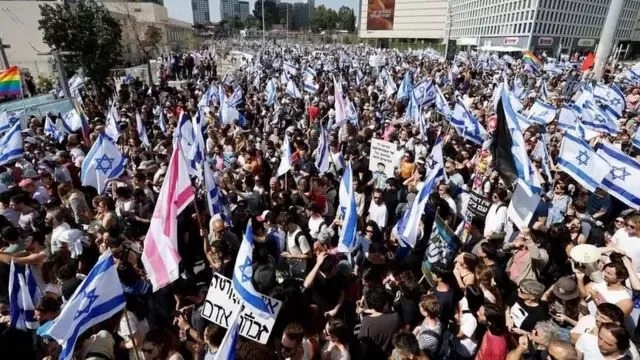
Scenario (1): Moving Forward with Tactical Adjustments Summary: The Israeli government continues its military plan with some tactical "braking" to avoid excessive internal/external costs. • Motivations: Netanyahu's calculations for political survival, the cohesion of the right-wing - far-right coalition, betting on a military "achievement." • What does it look like in practice? • Expanding limited/intermittent operations instead of a comprehensive continuous invasion. • Internal messages "We are listening to the families" while blaming Hamas for the hostages. • Increasing bombing/assassinations while managing the pace to avoid a larger public opinion shock. • Early warning indicators: 1- Continued arrests of protesters while avoiding widespread bloody clashes. 2- Government rhetoric promising "phases" and "humanitarian corridors" without changing the goal. 3- Conditional verbal American support (human rights criticisms without solid pressure tools). • Expected results: Slow erosion of the government's legitimacy internally; high human and material costs in Gaza; the hostage file remains without a substantial breakthrough. • Probability assessment: Medium - High. Scenario (2): Tactical retreat/postponement under internal-external pressure. Summary: No cancellation of objectives, but the invasion is "suspended" or "rescheduled" in the face of escalating civil paralysis and sharp messages from allies. • Motivations: Fear of the internal front spiraling out of control (economy/institutions), American-European pressure accompanied by tangible political/military costs, risks to the lives of the hostages. • What does it look like in practice? • Announcing a "reassessment of operations" and linking any move to the progress of hostage negotiations. • Accepting broader humanitarian arrangements (relief/corridors) to alleviate international pressure. • Escalating negotiation-intelligence efforts regarding the hostages in exchange for a temporary field calm. • Early warning indicators: 1- The Histadrut's involvement with import/port or electricity unions (real economic paralysis). 2- Leakage of American conditionality (freezing specific shipments/precision munitions) or linking support to a negotiation track. 3- Dissensions within the coalition or open rebellion from former security leaders. • Expected results: Cooling down of major operations; a wider hostage negotiation window; erosion of the image of "decisiveness." • Probability assessment: Medium. Scenario (3): Political setback and reshaping of the scene (overthrow or disintegration of the coalition) Summary: The protests turn into a sustainable movement that creates coalition rifts or leads to early elections/alternative arrangements. • Motivations: Accumulation of human/economic losses, increasing institutional resentment, exposure of failure in the hostage file. • What does it look like in practice? • Resignations/defections from pivotal coalition parties. • Decisive votes in the Knesset that the government fails to pass. • Transfer of the center of gravity to a transitional administration or an internal political deal. • Early warning indicators: 1- The expansion of the strike to include strategic sectors (airports, ports, banks, electricity). 2- Harsh rhetoric from former/current security leaders against the plan. 3- Explicit decline in opinion polls for Netanyahu with the rise of alternatives from within the right. • Expected results: Freezing the plan or completely redefining it; a compressed negotiation track on hostages and security arrangements; regional and international repositioning. • Probability assessment: Low - Medium (increases if economic paralysis turns into a continuous reality). What changes the equation quickly? (Pressure levers/turning points) • The Histadrut: The official entry of the major union immediately doubles the internal cost and brings us closer to scenario (2) or (3). • Realistic American conditionality: Linking military support to the cessation of specific operations/effective negotiation engagement that exerts strong pressure. • Hostage disaster: The death/killing of a group of hostages during field operations will overturn public opinion and severely weaken the government narrative. • Field surprise: A clear military failure or heavy losses for the army accelerates the tactical retreat. Implications for Gaza and the region • Gaza: In scenario (1), the humanitarian cost worsens without a political breakthrough; in (2), higher chances for humanitarian corridors and exchange/truce; in (3), a high probability of a broad freeze of operations and the launch of a more comprehensive negotiation track. • Israel internally: (1) Depletion of legitimacy and chronic social tension; (2) Social truce conditional on the success of the hostage file; (3) Resetting the government may be accompanied by painful deals. • Regionally: The prolonged war raises the risks of friction with other fronts; while retreat/freezing opens the door to security arrangements through regional mediations. Executive summary • Strikes and demonstrations will not stop the plan immediately on their own, but they will slow its pace and increase its political cost. • Transition to organized economic paralysis + tangible American conditionality + public opinion shock related to the hostages = highest probability of substantial postponement/freezing. • The best opportunity for structural change comes from the accumulation of internal institutional pressure, not from a single wave of protest.