


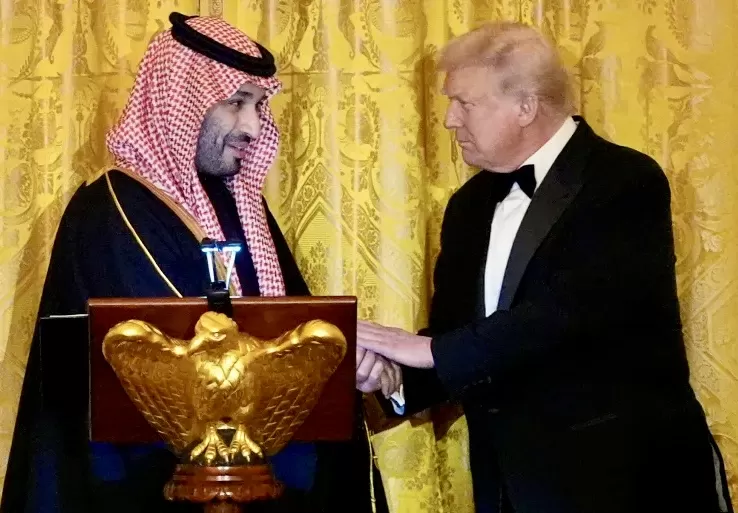
Saudi-American relations
The Gulf region is on the cusp of a new security architecture... After Saudi Arabia was designated a major ally of Washington: a strategic analysis.
Arabian Sea Newspaper - Special
The Gulf region on the cusp of a new security architecture... after designating Saudi Arabia a major ally of Washington Strategic Analysis: 1) Military Analysis — What does designating Saudi Arabia a major ally mean for the balance of power in the Gulf? Executive Summary Washington's decision to designate Riyadh a major non-NATO ally changes the tactical and strategic rules of the game in the Gulf. The military focus will shift from specific partnerships to an integrated defense cooperation structure: advanced technology transfer, logistical bases, joint training batches, and advanced radar/missile systems. This enhances Saudi Arabia's ability to manage local and regional crises and increases the cost of intervention for any hostile force in the region. Key Elements of Impact 1. Advanced Technology Transfer * Potential access to integrated air defense systems (such as advanced versions of Patriot/THAAD or long-range systems) and anti-aircraft missile capabilities and a multi-layered battery. * Possibility of joint production or local assembly of systems requiring software licenses and high sensitivity (making Saudi Arabia a partner in development programs reduces the time lag for deployment and self-reliance). 2. Building a logistical infrastructure and emergency deployment capabilities: * Storing American equipment for emergencies on Saudi soil reduces the response time of the American force in a crisis; gives the ability to quickly support allied countries logistically. * Joint operating bases for naval and air operations, repair and maintenance facilities for fighter aircraft and sensitive systems. 3. Strengthening intelligence and cyber cooperation – network integration: * Real-time intelligence exchange, integration of early warning systems, unified early warning network for missile and drone threats. * Cooperation in cyber defense and protection of vital infrastructure (ports, oil facilities, power grids). 4. Joint operational capabilities and training forces: * Joint training programs and construction operations for rapid intervention forces, transfer of expertise to elite units and counter-insurgency tactics and special naval operations. * Establishment of joint regional command centers to coordinate rapid response to events in the Red Sea and straits. 5. Updated regional deterrence – Iranian and proxy calculations: * Raising the cost of escalation for Iran and its proxies (Hezbollah, Houthis) through a faster ability to intercept maritime and air threats. * Notifying Iran that any attempts to destabilize Saudi Arabia may face a rapid response supported technically and logistically. Military Risks and Challenges * Regional arms race: The decision may prompt regional countries to seek counter-equations (Russian/Chinese support, expansion of ballistic or defensive capabilities), exacerbating tension. * Provocations and extreme dependence: The presence of advanced American equipment on the ground requires strict control mechanisms and usage standards to avoid accidents and miscalculation. * Maritime escalation potential: Linking American logistical bases and Saudi systems in the Red Sea and Bab al-Mandab may make maritime routes quick testing grounds for power competition. * Preemptive use by both sides: Any tensions may turn logistical bases into potential targets in the event of escalating conflict. Tactical Conclusion: The designation gives Riyadh new tactical and strategic tools: speed of response, logistical support, integrated air defense, and advanced intelligence capabilities. But it also brings escalation variables and constitutes an incentive for counter-maneuvers from competing parties. The last word will be for the level of political coordination between Washington and Riyadh to formulate rules of use and reduce the risks of friction. ⸻ 2) Economic Analysis — The impact of designating Saudi Arabia a major ally on energy markets and investments Executive Summary: Designating Saudi Arabia an American ally enhances market confidence in Riyadh's ability to protect production and supply lines, and gives it greater production and political influence in oil and gas markets. Markets may witness multiple reactions: reducing the risk of a sharp rise in oil prices in the short term, but in the medium term, the decision can increase Saudi Arabia's ability to play a strategic role in supply policies (OPEC+), and give it a greater margin to negotiate with Western investment partners in renewable energy and hydrogen projects. Immediate, Medium, and Long-Term Effects A. Immediate Impact (Weeks – Months) * Reduced geopolitical risk: The market reads the decision as a stabilizing factor; potential temporary decline in oil prices due to the impression of limiting the possibility of supply disruption. * Boosting investor sentiment: Capital markets will welcome increased political transparency and security guarantees for major projects, contributing to short-term investment flows to infrastructure and energy sectors. B. Medium-Term Impact (Months – 2 Years) * Strengthening Saudi Arabia's ability to manage supply: With more confident tools and better defense capabilities, Saudi Arabia may be bolder in managing production levels as a political-economic tool (increasing/decreasing supply as a pressure tool). * Expansion of clean energy investments: Technology partnership agreements with American and European companies to finance green hydrogen projects and carbon capture technologies, supported by better investment security. C. Long-Term Impact (2–10 Years) * Shift in market structure: Saudi Arabia will be able to play a pivotal role in accelerating energy transition through investments in both oil, gas, and hydrogen, with the possibility of accelerating local refining and value-added projects. * Strengthening reserves and spare capacity: Intelligence and logistical cooperation with Washington will enable Saudi Arabia to protect refining facilities and vital maritime crossings, supporting the continuation of uninterrupted supplies globally. Guiding Points for Oil and Commodity Markets 1. Oil Prices: In the short term, the potential for calming price volatility, but any Saudi use of production control through OPEC+ may restore price volatility. 2. Renewable Energy Investments: Potential increase in foreign direct investment (FDI) in renewable energy, hydrogen, and mining sector projects. 3. Market Risks: An arms race and regional tensions can quickly restore rising prices in the event of military events in vital straits. Recommendations for Investment Funds and Decision Makers * Capital Funds: Diversifying holdings in companies operating in renewable energy in the Kingdom, and infrastructure funds. * Governments and Oil Companies: Developing contingency plans for the supply chain; securing marine insurance and cyber security contracts for oil facilities. * Saudi Financial Sector: Leveraging improved confidence to issue international sukuk/bonds to finance long-term projects in hydrogen and clean energy. Economic Conclusion: The decision strengthens Saudi Arabia's position as a pivotal player in the global energy market. It creates significant investment opportunities, but it also raises the stakes of political and economic accountability and places the Kingdom at the heart of a competition for influence between major powers — which entails opportunities and risks for the global market. ⸻ 3) Brief Historical Timeline of the Development of Saudi-American Relations (Until 2025) Note: The dates below are focused on the most influential milestones in the alliance's path. 1950s – 1970s * 1945: The historic meeting between King Abdulaziz Al Saud and US President Roosevelt aboard the ship "Quincy" — the beginning of official relations after the discovery of oil. * 1950–1960: Establishing security and economic cooperation; oil agreements and American investments in infrastructure. * 1973 (October War): Temporary tensions (Arab oil embargo on the West), but relations recover later through diplomatic channels. 1980s – 1990s * 1980: Security cooperation against Soviet influence in the region; signing arms contracts and military exercises. * 1990–1991 (Gulf War): Saudi Arabia hosts American forces to repel the Iraqi invasion; a strong strategic security alliance. 2000s * 2001: Invasion of Afghanistan and the War on Terror — deep intelligence cooperation, but increasing international criticism on human rights issues. * 2003: Invasion of Iraq; a recognized Saudi role and continuous security and strategic relations with Washington. 2010s * 2015: Saudi intervention in Yemen; the relationship with Washington witnessed intersections and complexities due to international criticism of war operations. * Late 2010s: Economic interests (investments, energy security) restore a positive balance in the relationship. Early 2020s * 2020: Tensions due to human rights issues and the famous incident (Khashoggi's murder) that temporarily damaged the reputation of the relationship, but did not lead to a strategic separation. * 2021–2022: New American administrative transition, political reviews, but practical cooperation continued — especially in the fields of energy and intelligence. Mid/Late 2020s (The Decisive Phase Until 2025) * 2023–2024: Increasing security and economic understandings; investment projects under the umbrella of Vision 2030. * 2025 (Designation): The United States designates Saudi Arabia a major non-NATO ally — a formal step that moves the relationship to a deeper strategic partnership (joint development of weapons, intelligence cooperation, storage of logistical equipment). Features After 2025 (Expectations Related to the Designation) * Accelerating arms contracts and joint defense technologies (local manufacturing/assembly projects). * Broader economic partnerships including renewable energy, hydrogen, and high technology. * Readjustment of regional relations with the increasing role of Saudi mediation in regional files in exchange for a greater political maneuvering margin. ⸻ Conclusion: A Quick Read Linking the Three Parts The American designation of MNNA is not just a symbolic decision; it is a tactical and strategic element that translates long-term policies: from fortifying Saudi Arabia defensively (