

Saudi-Pakistani alliance
Comprehensive strategic analysis of the Saudi-Pakistani Joint Defense Agreement.
Arabian Sea Newspaper - Special
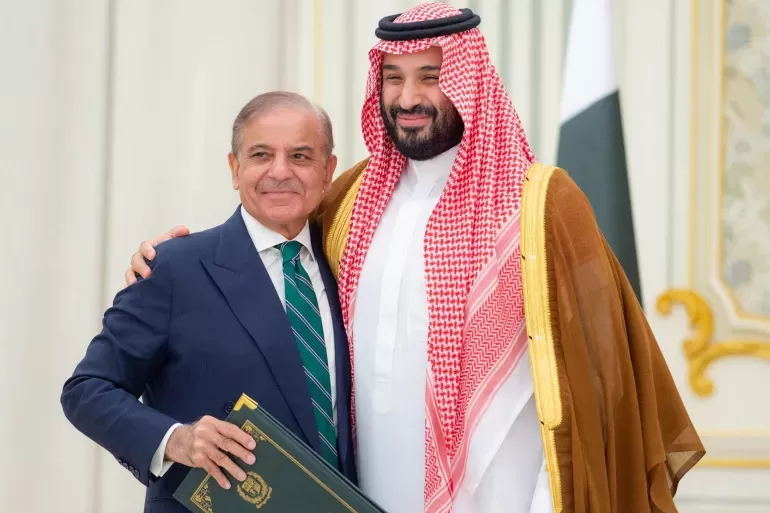
Comprehensive Strategic Analysis of the Saudi-Pakistani Joint Defense Agreement Introduction: On September 17, 2025, the Kingdom of Saudi Arabia and the Islamic Republic of Pakistan signed the Strategic Mutual Defense Agreement (SMDA), a move reflecting a fundamental shift in the dynamics of regional alliances. This agreement comes in the context of escalating tensions in the Middle East and South Asia, and within Riyadh's endeavor to strengthen its national security and reduce reliance on traditional Western guarantees, at a time when Pakistan possesses nuclear capabilities and extensive field military experience. The agreement represents an attempt to reformulate joint deterrence in the face of multiple regional challenges, including Iranian threats and the Houthi group in Yemen, as well as regional military balances with India and Israel. Strategic Dimensions 1. Strengthening Joint Deterrence: The agreement stipulated that "any aggression against one country is considered an aggression against the other," which raises the ceiling of deterrence and sets a clear equation for any party intending to harm the security of either country. 2. Reducing Dependence on the West: The agreement reflects Saudi Arabia's desire to diversify its security alliances away from the United States, especially in light of some recent political tensions in the region. 3. Deepening Military and Technical Cooperation: The agreement includes joint military training, intelligence sharing, and the development of advanced defense systems, while benefiting from Pakistani expertise in defense fields, drones, and even indirect nuclear deterrent capabilities. 4. Leveraging the Pakistani-Chinese Alliance: The Chinese-Pakistani alliance represents a major pillar of this agreement, as Saudi Arabia can benefit from Chinese technology, military equipment, and major infrastructure projects such as the China-Pakistan Economic Corridor (CPEC), which enhances strategic deterrence. Challenges and Risks 1. Relations with Iran and Ideological Hostility: The agreement will increase tension with Iran, which considers Saudi Arabia a major ideological and strategic adversary. Any strengthening of Saudi military capabilities through Pakistan will be seen in Tehran as a direct threat to its interests, especially in terms of Yemen and support for its affiliated groups. 2. Regional and International Reactions: • India: Will consider the agreement a threat to its national security due to Pakistani military support. • Yemen and the Houthis: The agreement may exacerbate conflicts on the southern border, considering that any Saudi military reinforcement will have direct repercussions on the course of the war in Yemen. • The United States and the West: Will monitor this agreement with concern, as it may be interpreted as a Saudi shift towards a Chinese-Pakistani axis, which rearranges traditional alliances in the region. 3. Internal Implementation Challenges: Military and intelligence cooperation requires full technical and political consensus, and the agreement may face obstacles in the transfer of technology or the sharing of sensitive information due to international restrictions or Pakistani reservations about some advanced weapons. Expectations and Future Outcomes 1. Strengthening Regional Military Deterrence: The agreement is expected to enhance joint defense capabilities, including missile systems, air defense, and drones, which may change deterrence equations in the Arabian Gulf and South Asia. 2. Impact on International Alliances: The agreement may push Saudi Arabia to expand its defense cooperation outside the Western sphere, which puts the United States in front of a new reality in the region and increases China's influence through Pakistan. 3. Effects on Regional Tensions: • Iran and Yemen: Strengthening Saudi military power could lead to increased tensions in Yemen, and perhaps a limited escalation against the Houthis supported by Iran. • India and Pakistan: Strengthening defense capabilities may raise the level of military readiness between New Delhi and Islamabad, which may open a new phase of the regional arms race. 4. Long-Term Outcomes: • Establishing a new balance in the Middle East and South Asia that enhances Saudi strategic independence. • Indirect Chinese involvement in Gulf security may lead to changes in alliance dynamics, and may encourage other countries to re-evaluate their traditional alliances. • The rise of Pakistan as a key player in Gulf security could change its regional position and increase its ability to influence regional policies. Conclusion: The joint defense agreement between Saudi Arabia and Pakistan is not just military cooperation, but a strategic step with regional and international dimensions, including rearranging alliances, strengthening military deterrence, and investing in the Pakistani-Chinese alliance. At the same time, the agreement carries significant challenges, especially with Iran, Yemen, India, and the West, making monitoring its results and developments an exceptional necessity to understand the course of regional security in the coming years. Strategic Chart – Relationships and Impacts Key Axes 1. Kingdom of Saudi Arabia • Objectives: Strengthening national security, diversifying alliances, reducing dependence on the West, supporting regional military deterrence. • Tools: Joint defense agreement with Pakistan, purchasing defense technology, developing indigenous military capabilities. 2. Pakistan • Objectives: Strengthening its regional influence, supporting strategic alliances, benefiting economically from Saudi cooperation. • Tools: Nuclear capabilities, extensive military experience, partnership with China (CPEC, advanced weapons). 3. China • Objectives: Strengthening its influence in the Gulf and South Asia, protecting its interests in the China-Pakistan Economic Corridor. • Tools: Military technology, financing infrastructure projects, logistical and strategic support. 4. Iran • Objectives: Confronting Saudi influence, supporting the Houthis in Yemen, maintaining its regional interests. • Tools: Supporting armed groups in Yemen, regional alliances, diplomatic pressure on the Gulf. 5. Yemen / Houthis • Objectives: Resisting the Saudi coalition, investing in the conflict to strengthen Iran's regional influence. • Tools: Missile and drone attacks, control of strategic areas, direct pressure on Saudi Arabia. 6. India • Objectives: Reducing Pakistani influence, protecting its national security. • Tools: Military readiness, regional diplomacy, alliances with the West. 7. United States / West • Objectives: Maintaining influence in the Gulf, monitoring any shift towards a Chinese axis. • Tools: Military and technical support for Saudi Arabia, diplomatic monitoring, regional alliances. Key Interactions Between Players Parties Relationship Type Agreement Impact Saudi Arabia – Pakistan Strategic Alliance Strengthening deterrence, military cooperation, investing in the Chinese alliance Pakistan – China Strategic Alliance Supporting military capabilities, CPEC projects, strengthening Pakistan's position in the Gulf Saudi Arabia – Iran Ideological and Strategic Hostility Increasing tension in the Gulf and Yemen, potential proxy clash Saudi Arabia – United States Tense Historical Cooperation Saudi Arabia reduces reliance on Western guarantees, strengthening strategic independence Pakistan – India Regional Hostility Strengthening military readiness, raising the level of tension between the two countries Saudi Arabia – Israel Limited Rapprochement The agreement may complicate rapprochement attempts, especially in light of Palestinian tensions Saudi Arabia – Yemen / Houthis Armed Hostility Strengthening Saudi military capabilities, potential escalation of military operations Expected Outcomes 1. Regionally: Strengthening Saudi deterrence, rebalancing power in the Gulf and South Asia, potential escalation in Yemen, new challenges for India and Iran. 2. Internationally: Reconsidering traditional Western alliances, strengthening indirect Chinese influence in the Gulf, US monitoring of any strategic shift. 3. Strategically: Saudi Arabia becomes a more independent player, Pakistan benefits from strengthening its regional influence, China achieves economic and strategic gains.