
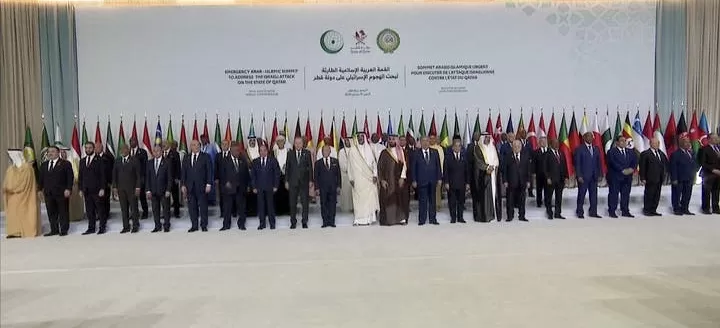
Doha Summit
Arab Islamic Summit Decisions in Doha and the Problem of Implementation
Arabian Sea Newspaper - Special
Arab-Islamic Summit Decisions in Doha: The Problem of Implementation Strategic Analysis - By Harb Al Arab Arab and Islamic summits represent pivotal moments in the history of inter-relations between Arab and Islamic countries, often convened during major crises or strategic challenges targeting shared national security and the region's position in the international system. The Arab-Islamic Summit in Doha comes as a direct response to escalating political, military, and economic threats, foremost among them the wars that affect the core interests of Arabs and Muslims. However, the fundamental problem lies not in the content of the decisions or the strength of the declared positions, but in the extent to which they are implementable on the ground. Historical experience shows a recurring gap between "political discourse" and "practical application," making many of the outcomes of these summits closer to slogans than to actionable strategies. First: Analyzing this phenomenon requires examining three interconnected levels: 1. The Structural Dimension: The nature of the Arab and Islamic system, the mechanisms of collective decision-making, and the extent of its binding force. 2. The Geopolitical Dimension: The overlapping interests of major powers, the inter-state conflicts between Arab and Islamic countries, and their impact on implementation opportunities. 3. The Strategic Dimension: The relationship between the declared decisions and the reality of the ongoing war, especially in light of the "War of the Arabs," which reveals the fragility of solidarity and the challenges to national security. Accordingly, studying the decisions of the Doha Summit from a strategic perspective is not merely monitoring texts or final statements, but an attempt to understand the complex balances that govern Arab and Islamic political action, and to dissect the problem of implementation as the weakest link in the collective action process. • International Legal Action: Filing cases before the International Court of Justice and the International Criminal Court. ٠ Impact: Puts Israel under continuous judicial pressure and gives Arabs and Islamists a strong political and media tool. • Political Support for Palestine and Qatar: Unified statements + media campaigns + financial support for Palestinian institutions. ٠ Impact: Strengthens the unity of position and restores the Palestinian cause to the forefront. ٠ Economic Steps and Comprehensive Boycott: Such as stopping trade or preventing Israeli companies from entering Arab and Islamic markets. ✦ Impact: Would be strongest if implemented collectively, but requires collective will, which is the most difficult due to differing state interests. Second: The Problem of Implementation 1- Rapid Action Track (Short-term - Realistic and Implementable) • International Legal Action: Filing cases before the International Court of Justice and the International Criminal Court. ٠ Impact: Puts Israel under continuous judicial pressure and gives Arabs and Islamists a strong political and media tool. • Political Support for Palestine and Qatar: Unified statements + media campaigns + financial support for Palestinian institutions. ٠ Impact: Strengthens the unity of position and restores the Palestinian cause to the forefront. 2- Organized Pressure Track (Medium-term - Requires Political Consensus) • Coordination at the United Nations: Drafting resolutions through the General Assembly and the Security Council (even with the American veto, it remains an important symbol). ٠ Impact: Shows Israel as internationally isolated and increases the legitimacy of the Arab position. • Reducing Diplomatic Relations: Some countries can gradually reduce the level of representation (from ambassador to chargé d'affaires) or cut off completely. ٠ Impact: A strong political message without significant losses for these countries. 3- Major Escalation Track (Long-term - Difficult to Implement) • Economic Steps and Comprehensive Boycott: Such as stopping trade or preventing Israeli companies from entering Arab and Islamic markets. ٠ Impact: Would be strongest if implemented collectively, but requires collective will, which is the most difficult due to differing state interests. Strategic Conclusion: • The most realistic tools now: International legal action + political and media support. • Possible tools later with good coordination: UN action + reduction of diplomatic representation. • The least likely tool, but the strongest if it happens: Economic boycott.