

United States Department of War
U.S. War Department: Renaming or Redefining Global Strategy?
Arabian Sea Newspaper - Special
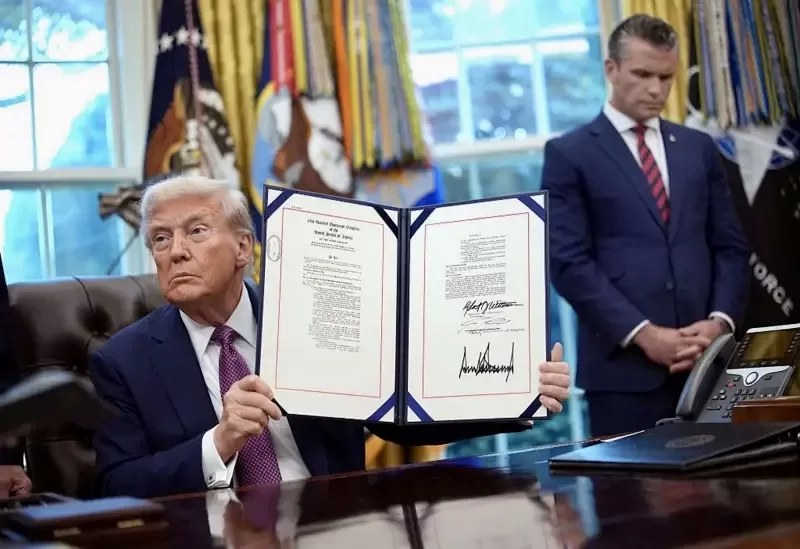
U.S. Department of War: Renaming or Redefining Global Strategy? Strategic Analysis - Arabian Sea U.S. President Donald Trump's announcement to rename the Department of Defense to the "Department of War" is an event that goes beyond symbolic language into the space of deep strategic calculations. The name is not a formal detail, but a tool to reformulate the consciousness of the inside and outside with a clear message: the United States is no longer satisfied with the logic of "defense," but places itself in the position of initiating the attack and having the upper hand in the balance of power. From the perspective of objectives, the decision appears as part of a broader project to re-militarize political discourse, enhance deterrence through a show of prestige, and link the military establishment to the concept of "victory" rather than "fortification." On the level of the hidden, the transformation is linked to an attempt to restore the "warrior spirit" in the face of what Trump describes as ideological deviations within the army (diversity programs, political correctness), in addition to preparing the ground for more offensive strategies towards adversaries such as Iran, China, and Venezuela. In the balance of consequences, this decision raises several possibilities: internally, it may consolidate the division between those who see it as a "return to power" and those who consider it a "costly adventure." Externally, it may cause allies to worry about Washington's drift towards hostility, while giving its adversaries propaganda material to portray it as a power thirsty for wars. Strategically, the new name may become a tool of pressure in international politics—a psychological weapon more than an institutional change—but it nevertheless heralds a stage whose title is: Peace through strength... or war without masks. Situation: U.S. President Donald Trump signed an executive order restoring the Department of Defense's historical name: the Department of War. The decision allows the use of the new titles in official correspondence, with the White House seeking to legislate it through Congress. Republicans celebrated it as a tribute to the history of the military establishment, while Democrats attacked it as a dangerous "militarization" of American political discourse. Objectives: 1. Trump personally: To solidify his image as a leader of hard power, restoring the nation's "spirit of victory" away from the language of defense and reservation. 2. The Republican Party: To invest the decision in strengthening the conservative popular base that believes in military decisiveness. 3. The military establishment: To restore its history as a victorious war tool, not just a defensive apparatus. 4. Abroad: To send a clear deterrent message to adversaries (China, Russia, Iran) that Washington is moving from a discourse of defense to a discourse of war. The Hidden: • The timing coincided with the escalation of crises in the South China Sea and the Middle East, making the change part of the battle of geopolitical messages. • Trump is betting that the move will restore internal cohesion before the upcoming elections, as he combines historical symbolism with electoral politics. • Within the institution, the decision is controversial: some military leaders consider it a political tool that may embarrass the Pentagon in front of allies, while others see it as an opportunity to boost arms budgets. Consequences: 1. Short-term: Increased intensity of internal political discourse, and increased division between Republicans and Democrats over the role of the army. 2. Medium-term: Deepening the militarization of American foreign policy, which may prompt European and Asian allies to recalculate their strategic calculations. 3. Long-term: The decision paves the way for an ideological shift in American policy: from a state that "defends when necessary" to a state that "declares war when needed." 4. Regionally and internationally: America's adversaries may respond with counter-steps, such as strengthening their military alliances (China, Russia, North Korea, Iran with its allies), which heralds a new round of the arms race and the reshaping of the global deterrence balance. Strategic Conclusion: The renaming is not just nostalgia for history, but a step that reflects Washington's return to the logic of naked power. It is a redefinition of the essence of the American state in the coming decade: A state that sees itself as a war actor first, and a diplomat second.