

Chinese military parade
Beijing Military Summit: A Show of Force or a Declaration of a New World Order?
Arabian Sea Newspaper - Special
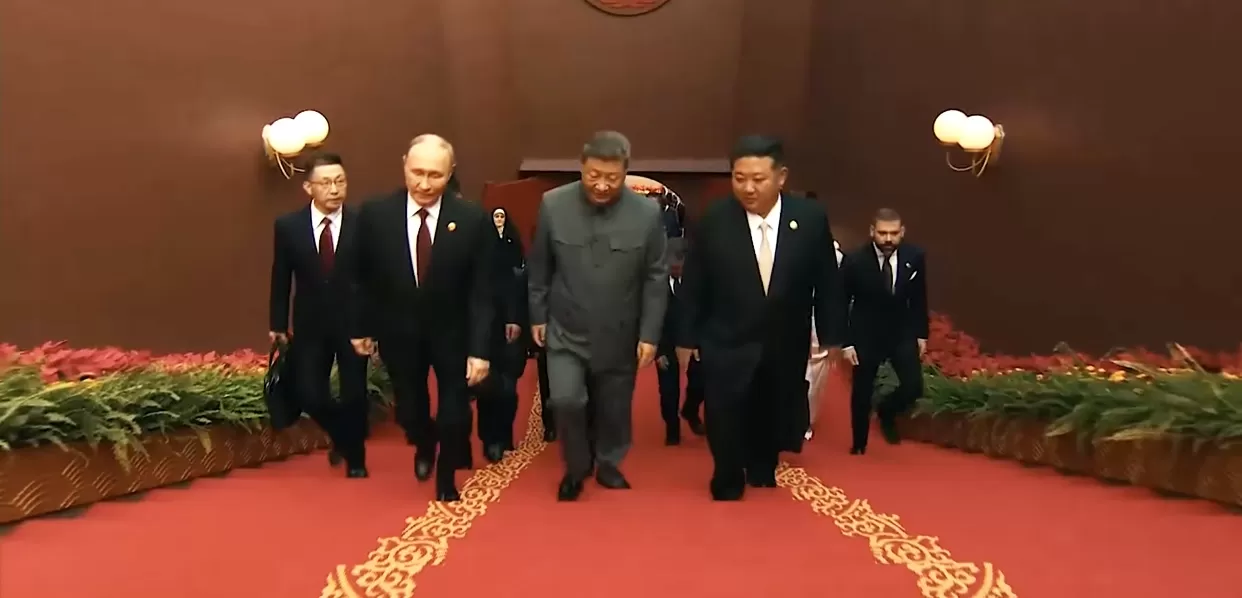
Beijing Military Summit: A Show of Force or a Declaration of a New World Order? Strategic Analysis - Arabian Sea First: The Event — What Happened? * China organized a massive military parade in Beijing to commemorate the 80th anniversary of the end of World War II, in an unprecedented public trio gathering Xi Jinping, Vladimir Putin, and Kim Jong-un. During it, Xi said that the world faces a historic choice between "peace or war," in a message directed at the West and its allies. * The displays showed a qualitative leap in armament: hypersonic missiles, naval/undersea drones, and air defense systems and intercontinental ballistic missiles; some of which are being shown publicly for the first time. * The side meetings cemented the scene of an "Eastern Triangle": Kim pledged to support Russia and discussed with Putin a longer-term strategic partnership. Second: The Reality — Where Do We Stand Now? * Convergence of interests, not a formal defense alliance: The images and political language reflect a clear alignment, but without a collective defense treaty like NATO; it is a multi-track coordination (armament, economic, informational) more than a closed alliance. (Conclusion supported by the nature of public messages and the differing priorities of the parties). * Escalating global cost: The momentum of Asian armament coincides with the disruption of debt markets and the high cost of financing in the West—reducing the margins of strategic maneuver for Atlantic capitals. (Contextual reading of the "peace or war" speech with the current global economy). Third: The Objectives — What Did Beijing, Moscow, and Pyongyang Want? * China: To establish the image of a "system-creating power" not a "revising one"; using historical symbolism to legitimize a new balance of deterrence extending from the Western Pacific to the Indian Ocean. Showing asymmetrical systems (hypersonic / drones) to deter powerful adversaries at a lower cost. * Russia: To transform the pressure in Ukraine into an Eastern alliance asset; to show that it is not isolated and that it has a political-industrial depth that enables it to prolong the conflict on better terms. * North Korea: To upgrade its status from a marginal player to a celebrated partner in a declared axis, deterring Washington, Tokyo, and Seoul and raising the price of any future settlement on the peninsula. Fourth: The Subtext — What's Between the Lines? * Targeted armament message: Highlighting naval platforms and undersea drones suggests the priority of straits and seas of the Asian rim (Taiwan, South China Sea, the First Island Chain), with an "access denial/area denial" A2/AD tactic to restrict Western fleets. * Image diplomacy: The group shot of Xi-Putin-Kim and a wide spectrum of international leaders and officials aims to normalize the scene of an "anti-Western gathering" in front of global public opinion, even if the interests of those present differ. * War of narratives: The "peace or war" formula is an attempt to attach the cost of escalation to the West, while marketing China as a force that "protects stability" while accelerating military modernization. (Narrative reading supported by analysis of the Western press). Fifth: The Outcomes — Where Are Things Heading? Short Term (0–6 months): * Intensification of deterrence messages around Taiwan and the seas of Asia, and increased asymmetrical armament tests/demonstrations. Possibility of symbolic/partial trilateral maneuvers to deepen the image of the "Eastern Triangle." * Medium Term (6–18 months): Expansion of the "Cold War economy" globally: a hidden race in defense supply chains, and increased competition for semiconductors and strategic materials, with higher financing pressures on Western economies. (Conclusion based on the coincidence of militarization and financial pressures). * Long Term (18+ months): A new dual positioning: "An Atlantic bloc exhausted by financing" versus "An Eastern bloc that masters denial/prevention tools." Not an explicit military alliance as much as a system of adjacent axes competing for technology, sea lanes, and political influence through third parties. (Analytical conclusion consistent with the nature of the current alignment). Sixth: What Should Be Monitored? 1. The pace of unveiling new platforms (hypersonic/autonomous naval/laser) in China during 2025–2026. 2. The level of North Korean involvement in supporting Russia, and the nature of the trade-offs (food/energy/technologies) that enable Pyongyang to withstand sanctions. 3. The reaction of markets and Western policies: To what extent does the rise in bond yields allow for the sustainability of high military spending without internal political cost? (Context of the current Western political economy). Editorial Conclusion: The display was not a protocol but a strategic statement of intent: China says it is capable of imposing a multi-domain deterrence equation, Russia faces its isolation with "Eastern legitimacy," and North Korea moves from the margin to a seat in the picture. The world is not returning to a traditional "Cold War" as much as it is entering an era of flexible axes in which power is managed through technology, supply chains, and the legitimacy of narratives as much as it is managed through armies.