

Shanghai Summit - Reality - Goals - Outcomes
Shanghai Cooperation Organisation Summit Today in Tianjin: A Precise Resetting of the Global Balance of Power
Arab Sea Newspaper - Special
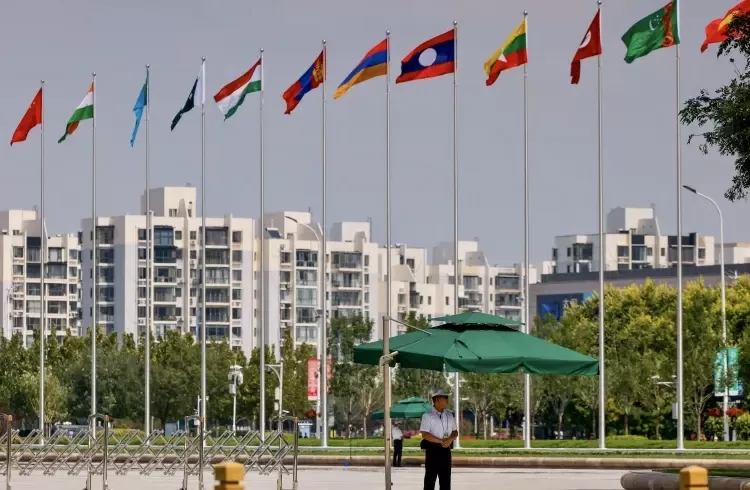
Shanghai Organization Summit Today in Tianjin: A Precise Reset of Global Power Balances Strategic Analysis - Special - Arabian Sea Intensive Introduction With the regular gathering of "Shanghai" leaders in Tianjin (August 31 - September 1), the presence of Vladimir Putin, and the meeting of Xi Jinping with Narendra Modi, the scene seemed closer to a new calibration moment for the international system: an advanced test of the idea of multi-polarity as it goes beyond the slogan to practical arrangements in security, economy, technology, and finance. Putin's presence, the Chinese-Indian meeting, and the expansion of the circle of participants, all indicate that the summit is not just a protocol event, but a platform for redistributing the weights of regional and global influence. Objectives: The Declared and the Implicit 1) China: From "Rising Power" to "Multilateral Coordinator" • Declared: Establishing "Shanghai" as a comprehensive framework for security and development, and demonstrating the ability to bring regional adversaries together under one roof. • Implicit: Deepening strategic networking with Russia and recycling influence with India by cooling down conflict borders, thereby reducing the cost of friction and freeing up resources for economic and technological challenges with the West. The Xi-Modi meeting suggests an effort to lower the temperature on the borders in favor of a broader development agenda. 2) Russia: Breaking Isolation with the "Mobilizing the East" Equation • Declared: Coordinating security positions and accumulating international legitimacy to balance the West. • Implicit: Expanding trade, diplomacy, and defense outlets, and demonstrating that sanctions have not excluded Moscow from the alliance game, but rather pushed it to deepen it eastward. 3) India: Geometric Balance Between China and the West • Declared: Gradually turning the page on border tensions, and constructive engagement within "Shanghai." • Implicit: Maximizing the margin of movement between Washington and Brussels on the one hand, and Beijing and Moscow on the other; that is, transforming "Tianjin Square" into a negotiating lever with all parties. 4) Central Asia and the Rest of the Members: Diversifying Umbrellas • Declared: Combating terrorism and developing infrastructure and trade. • Implicit: Reducing dependence on one axis, and capturing the gains of competition between the major powers within a broad institutional framework for "Shanghai." (The expansion of membership and attendance indicates this.) Instruments of Influence Under Networking • Security architecture without solid defense commitments: "Shanghai" is not "NATO," but it creates an environment of security and intelligence coordination that reduces the risks of miscalculation and increases the cost of exclusion. • An economy that rewards flexible alignment: This year's summit agenda is loaded with messages about trade and supply chains in light of renewed US tariffs; which pushes towards settlement arrangements and longer-term contracts between "Shanghai" members. • Diplomacy of images and bilateral meetings: The image of Putin in Tianjin, and the handshake between Xi and Modi, are not protocol details; they are "market signals" that reprice political risks in Asia. First Results (Short Term Outcomes) 1. Deliberate reduction of Chinese-Indian tension: The pledge to settle border disputes opens a loophole to recycle the relationship towards managed competition, not a draining conflict. This alone restores the weight of "Shanghai" as a producer of stability, not just a forum. 2. Restoring the image of the Chinese-Russian axis: The high-level presence enables Moscow and Beijing to market "alternative legitimacy" at a moment of increasing Western pressure. 3. Expanding the margins of intermediate countries: The more divergent Washington's trade policies become, the higher the appetite of Asian capitals to bet on alternative or complementary regional arrangements. Strategic Outcomes: Three Possible Paths Path A — "Establishing Coordinated Multilateralism" • Hypothesis: Success in cooling the Chinese-Indian front and transforming "Shanghai" into a flexible economic and security operations room. • Result: A relative decline in the potential for Asian escalation, and an increase in Asia's weight in controlling the prices of energy, critical minerals, and electronics chains. Path B — "Managed Cold Competition" • Hypothesis: The Chinese-Indian border remains under control but without final solutions, while Western tariffs and sanctions escalate. • Result: Settlement arrangements in local currencies and the integration of land-sea corridors within Asia expand, while the risk of localized geopolitical "splinters" remains. Path C — "Return of Acute Tension" • Hypothesis: The collapse of the Chinese-Indian de-escalation path or a major shock (security/trade). • Result: The reversion of "Shanghai" to a limited coordination forum, the evaporation of the gains of the current moment, and the return of Asia to an equation of acute binary polarization. Where Does the Balance of Power Actually Change? • In the ability to set the agenda (Agenda-Setting): China's hosting of the largest "Shanghai" summit to date, and the mobilization of more than 20 leaders, puts Beijing in the position of regional "organizer," not just a player. • In the structure of flexible alliances: The Xi-Modi meeting, and its prominence, indicates that Asia is testing a formula of "competitive coexistence" as an alternative to the logic of solid alliances. • In the "legitimacy" of institutional alternatives: The intensive appearance of "Shanghai" frames the Russian narrative and gives it a communication platform with the "Global South," even without binding defense commitments. Special Implications for the Arab World • Diversifying partners without rupture: The moment is opportune to formulate balanced supply, technology, and financing contracts between East and West, instead of being dependent on one axis. • Betting on "beneficial competition": Investing it to extract better terms in energy, petrochemicals, green minerals, and ports. • Risk management: Separating defense from the economy where possible, while enhancing the flexibility of supply chains (alternative corridors, smart storage, hedging contracts). Editorial Summary The Tianjin summit for "Shanghai" is not a declaration of victory over an existing international system, but a precise specification of how to engage with it: Establishing China as a coordinator of multilateralism, repositioning Russia through eastern legitimacy, and a pragmatic Indian rise that transforms the border from a strategic burden to a negotiating card. If this translates into viable economic and security mechanisms, we will be facing a new balance of power with Asian borders and global equations — a balance that does not overturn the West, but forces it to reprice.