


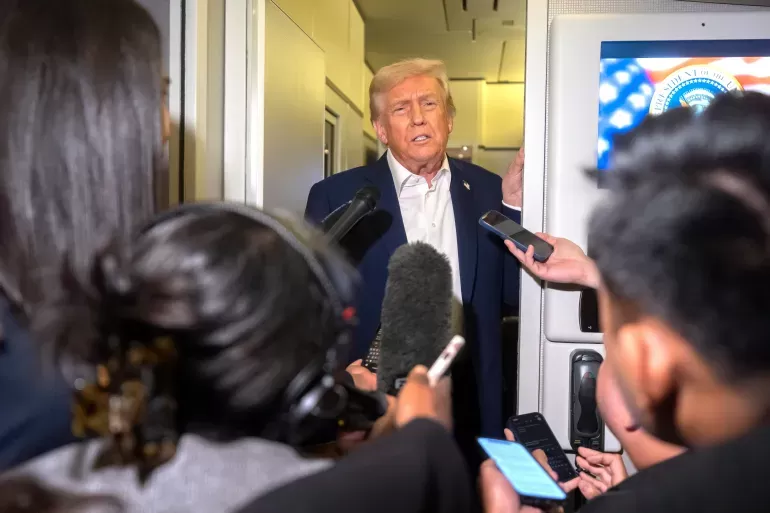
Trump, the Pentagon, and the Press: A Minefield Relationship
Arab Sea Newspaper - Follow-ups
The relationship between US President Donald Trump and the media has become clearly problematic and a source of much controversy, moving from verbal attacks and accusations in his first term (2017-2021) to tangible institutional and legal measures in his second term, which began in 2025. In his first term, Trump described the media as the enemy of American society, but with his current term, he has systematically targeted media institutions such as CNN and The New York Times, excluded others from entering the US Department of Defense (the Pentagon), such as the Associated Press, and began investigating other media networks. Regarding the assessment of American press freedom in the Trump era, and the path of escalation and confrontation, the Center for American and Arab Studies published a study entitled "The Pentagon Restricts Press Freedom... Escalation and Confrontation" prepared by researchers Munther Suleiman and Jaafar al-Jaafari. The study addressed the course of the crisis between the US President and the media, the decline of press freedom in the United States, and the future of coverage under these circumstances. Press Freedom and its Future in the United States President Trump's new strategy in his second term has had a tangible impact on the global ranking of press freedom in the United States. Reports from Reporters Without Borders indicated that the United States fell to 57th place in the 2025 World Press Freedom Index, with its status being classified for the first time as "problematic" rather than "satisfactory." In light of this trajectory, Trump's relationship with the press seems to be heading towards further escalation, as the issue is no longer just a political dispute, but has become a real test of the constitutional guarantees that protect press freedom in America. In recent weeks, the relationship between the press and the Pentagon has become unprecedentedly strained after US Secretary of Defense Pete Hegseth imposed new restrictions requiring journalists to sign a pledge not to publish any information without prior approval from the ministry. These restrictions have been strongly rejected by most major American media outlets, prompting many of them not to sign and lose their entry permits to the Pentagon. The recent interaction between the Pentagon and the media may reflect a new scene characterized by the following: 1 – A sharp decline in transparency: Because the departure of a large number of key correspondents from the Pentagon will weaken the ability to monitor and hold accountable the largest military institution in the country. 2 – The existence of two presses: one official, represented by the loyal media that signed the pledge, and another independent, which rejects these restrictions and covers military affairs from outside the walls of the Pentagon. 3 – A potential legal battle: As media institutions are still studying legal challenges, this issue may end up in the courts to decide on the undermining of their professional freedom. Restrictions and Potential Constitutional Violations The new policy adopted by Hegseth in regulating the media field within the Pentagon is summarized in the following main points: Prior approval for publication: The pledge requires journalists to obtain approval from a Pentagon official before publishing any information, even if it is not classified as official secrets. Restriction of freedom of movement: Journalists are no longer allowed to move freely in the corridors of the Pentagon, and their presence is limited to specific areas with the need for an official escort in many cases. Consequences of refusal or violation: Refusal to sign the pledge or violation of its terms will result in the withdrawal of the permit granted and prevent the journalist from entering the building. Experts and activists in the field believe that this policy contradicts the American Constitution, which guarantees freedom of the press and freedom of expression, while requiring prior government approval for the publication of information is considered a form of prior censorship, which is one of the most serious forms of violation of freedom of expression. This policy also contradicts the public's right to access knowledge and obtain independent reports on the military institution, which is funded by taxpayers' money, which undermines transparency and accountability. For these reasons, the majority of media outlets announced a collective rejection of signing the new conditions and described them as unprecedented and insulting, and human rights organizations such as the "Reporters Committee for Freedom of the Press" considered that they could be exploited "to silence independent reports." Threatening Press Freedom The new restrictions imposed by the Pentagon directly and negatively affect the quality of news coverage, as they undermine the ability of journalists to perform their basic role in monitoring power and informing the public of accurate information. It is clear that the measures taken by Hegseth fall in a legally gray area and face fierce opposition, as their final fate is expected to depend on the outcome of any potential legal battle, as reports indicate that major media outlets are preparing to wage a legal battle against the Pentagon's policy, which may prompt the American judiciary to decide on its compliance with the Constitution. There are growing fears that if this policy succeeds, a similar model may be applied in other government sectors, undermining the press's ability to monitor the work of the government more broadly. The most important thing is that these measures contradict the basic principles of independent journalism, which academic studies emphasize its importance, as many of the conditions set by the new administration for journalists to enter the Pentagon prevent them from performing their oversight role over the work of government institutions funded by taxpayers' money, which deprives the public of its right to knowledge and weakens public accountability, and this is negatively reflected on transparency and accountability. In addition, the expulsion of certain media outlets and the preference of other loyal ones leads to the creation of an unbalanced media environment, in which the news content reflects only one narrative, which harms the public's ability to form informed opinions. The Future of Coverage Under These Restrictions Despite these challenges, major media institutions have announced their intention to continue coverage using alternative strategies and adhere to the principles of free and independent journalism, and the future may witness two parallel trends: 1- Strengthening investigative journalism: Media outlets may increase their reliance on external investigations and cooperation with internal sources to compensate for the weakness of direct access. 2- Resorting to the judiciary: Legal challenges to these policies are likely to escalate, as some media outlets are preparing to wage a legal battle to challenge their constitutionality. The study indicated that these restrictions may push the quality of news coverage towards more superficiality and dependence on the official narrative, which prevents the public from obtaining transparent, accurate and independent reports on defense and national security affairs that concern the public interest. In this context, most major American media outlets refused to sign the document of new restrictions imposed by the Pentagon on journalists, and among the most prominent rejecters are The New York Times, The Washington Post, The Wall Street Journal, and CNN. In contrast to this rejection, the document was signed by "One America News," a news channel known for its positions in support of President Trump. Source: Al Jazeera - Arab Press