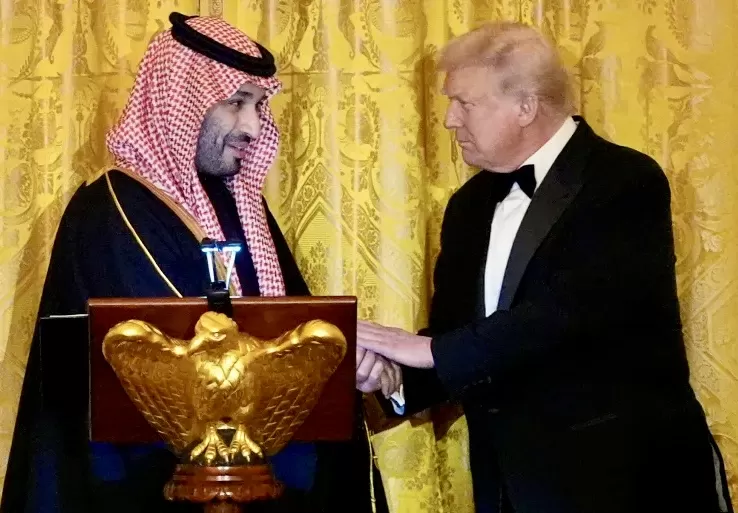



Trump's decision to designate the Muslim Brotherhood as a terrorist organization.
Trump's Decision on the Muslim Brotherhood... A Reading of the Motives, Secrets, and Consequences
Arab Sea Newspaper - Special
Trump's Decision on the Muslim Brotherhood... A Reading of the Motives, Secrets, and Outcomes Strategic Analysis: 1. Introduction: An Event Bigger Than Just a Designation U.S. President Donald Trump's decision to begin procedures to designate branches of the Muslim Brotherhood as "terrorist organizations" is not a passing decision, but a transformation that redraws the lines of political and religious influence in the Middle East. The step carries political and weighty significance, and its repercussions go beyond the legal listing to reshaping the balance of power in the region. 2. The Event in its International Context The decision comes at a turbulent regional moment: * Intensified regional competition between Egypt, Saudi Arabia, and the UAE on one hand, and Turkey and Qatar on the other. * Escalation of the war in Sudan with accusations of ideological interference. * Internal pressure in the United States to redefine "political Islam." Trump, with his return to the presidency, expresses a desire to reformulate the international security landscape according to the "ideological enemy" approach, not "military threat only." 3. The Event in the Balance of American Strategy A - Declared Objectives * Confronting "transnational groups" that Washington believes affect its interests and allies. * Drying up funding networks linked to groups with intellectual and political extensions. B - Undeclared Objectives (Strategic Secrets) 1. Restoring Relations with Washington's Traditional Allies The decision is in line with the demands of Arab countries that see the Brotherhood as a direct threat. 2. Restricting Turkish and Qatari Influence Designating Brotherhood branches strikes at the soft power tools of Ankara and Doha, and limits their ability to move through political and advocacy fronts. 3. Readjusting the Balance within "Sunni Islam" The United States is trying to support traditional religious currents at the expense of political Islam; this reshapes the religious landscape in favor of more governmental stability and less ideology. 4. An Internal Message to the American Voter Trump is addressing his conservative base through security-ideological decisions, especially after years of controversy over immigration and terrorism. 5. Regional Impacts: Redistributing the Cards A - Egypt: Consolidating the Official Narrative The decision is the biggest political victory for Cairo since 2013, and gives it American legitimacy in its war against the Brotherhood. B - Jordan: A Sensitive File Under Pressure The group there has historically been part of political life. The decision may push Amman further to restructure its relationship with them or gradually isolate them, which has already begun. C - Lebanon: Small Branches... But Sensitive The designation may be used as a pressure tool in the complex sectarian and political landscape. D - Sudan: The Most Dangerous Repercussions The existence of accusations of ideological affiliations of some parties to the conflict means that the decision may redistribute alliances, or change the balance of international support. E - Turkey and Qatar: Losing an Important Pressure Tool The designation limits the ability of the two countries to use the Brotherhood as a soft political power, creating a vacuum in influence tools. 6. The Deeper Secrets: The American Long-Term Game There are three long-term motives that go beyond the event itself: 1. Building a "New Middle East Order" Washington seeks to formulate a less explosive political environment after 20 years of wars and chaos. 2. Redefining "Religious Political Legitimacy" Transferring power from political Islam to traditional institutional Islam, and strengthening the state at the expense of transnational organizations. 3. Testing the Responses of Different Wings within the Brotherhood Washington wants to draw an accurate map of the group's divisions: Which of them is a reformist current? Which of them is a hardline current? Who is engaged in political work? Who provides financial support? 7. Outcomes and Future Scenarios Scenario One: Comprehensive Designation (20%) A number of branches are listed at once. This scenario creates: * An international financial blockade * A wave of arrests in Arab countries * Cutting off funding routes * Great pressure on Turkey and Qatar. Scenario Two: Partial Designation (50% - Most Likely) Targeting specific branches (Egypt - Lebanon - Jordan - Sudan). But the group as a global entity remains without a comprehensive designation. This scenario allows Washington to use the card for future political purposes. Scenario Three: A Symbolic Long-Term Decision (30%) The White House is given a pressure card without full implementation. And the file turns into a "negotiating tool" in major issues: gas, normalization, regional security. 8. Conclusion: The Decision is Not the End of the Battle but the Beginning of a New Phase Trump's decision is not a technical administrative event; it is a strategic message that says Washington wants to rearrange the tools of influence in the region. The Brotherhood - as a vast and complex organization - is now entering a phase of "redefinition": Who are the politicians? Who are the preachers? Who are those involved in armed conflicts? The next stage will be a test of the group's ability to adapt, the ability of countries to absorb the new variable, and Washington's ability to manage a sensitive card that may change the relationship between political Islam and the West for a whole decade.