

Latin American Arabs... From Immigration to Presidential Palaces
A procession of presidents and politicians from Lebanon, Palestine, and Syria who left their mark on the history of the modern continent.
Arab Gulf Newspaper - Middle East - Kawthar Wakil:
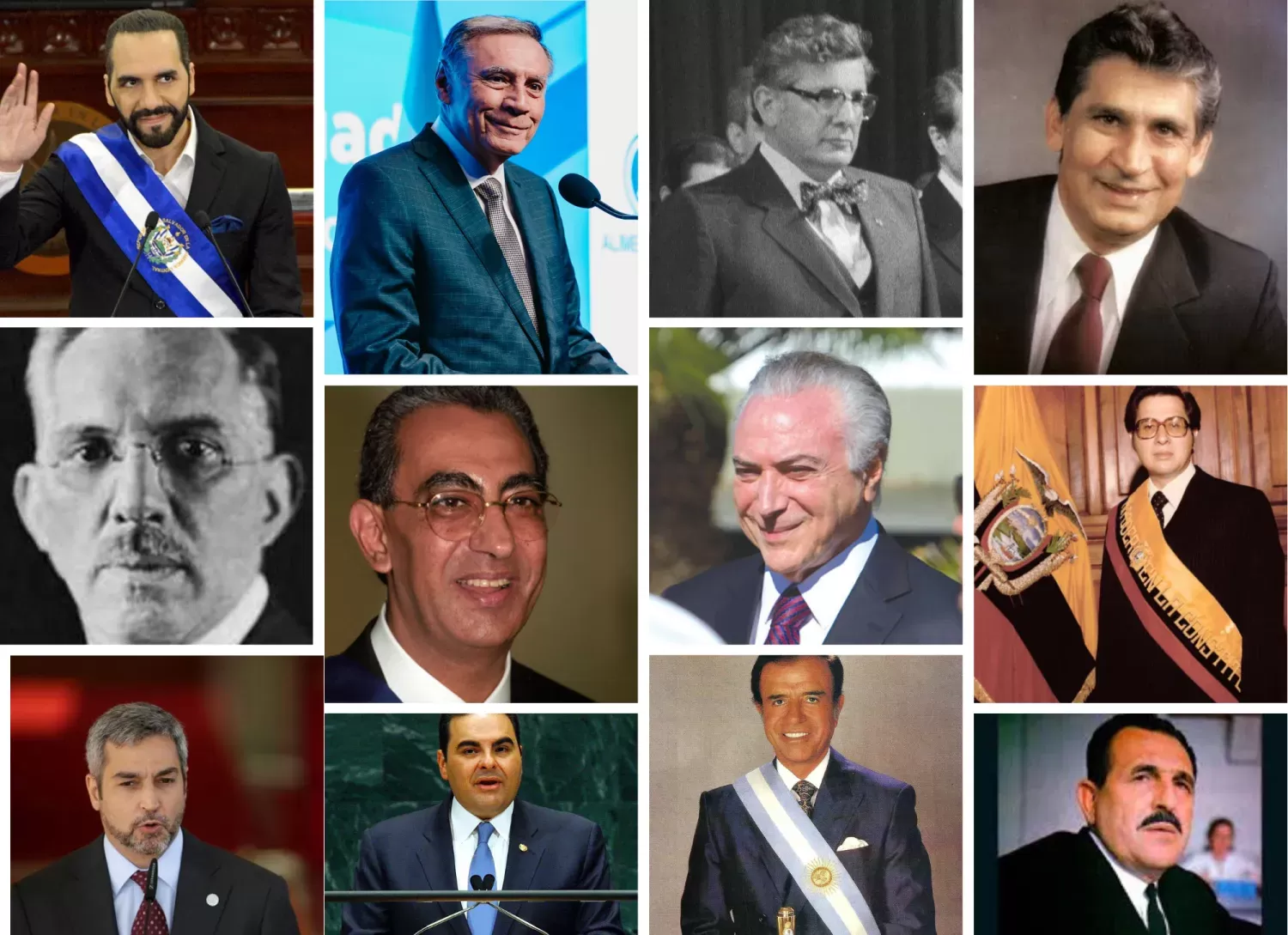
The Arabs who set off for Latin America carried only small bags and heavy memories that they left behind between the mountains of Lebanon, the houses of Palestine, and the alleys of Syria. They arrived in the distant continent in search of a more expansive life, but what no one expected was that their children would, after a few decades, become faces that topped the screens, sat in the palaces of power, signed treaties, and wrote new chapters in the history of countries where their first dreams were not born. Between Asunción, San Salvador, Guayaquil, and Bogotá, passing through Buenos Aires and Tegucigalpa, and reaching Brasilia and Quito, the Arab communities wove a different story; a story that begins with a small shop, then rises through universities and parliaments, to reach at the end of the ladder the highest position in the state. The following is an overview of the most prominent Arab politicians who left their mark on the history of Latin America. Colombia - Julio Turbay: The First Arab at the Summit Julio César Turbay Ayala is considered the symbolic starting point for the rise of Arabs to the presidency in Latin America. He immigrated with his family from the town of Tannourine in the Batroun district of the North Governorate of Lebanon to Colombia in the 1920s, when he was two years old. The Turbay family went through difficult times, and he had to leave school in high school and work early to support his family, a point that his political opponents kept waving throughout his career. After the family regained its economic status, Turbay joined the Liberal Party, rose through the diplomatic ranks, became ambassador to the United Nations, then ambassador to Britain and the United States of America, and was appointed Minister of Foreign Affairs, before assuming the interim presidency in 1967, then was elected president of the Republic from 1978 to 1982 in one of the most difficult stages of Colombian politics. His presidency witnessed an international crisis precisely on February 27, 1980, when a group of 35 fighters from the "M-19" movement stormed the Dominican embassy in Bogotá during an official reception on the occasion of a national holiday, and held hostage the ambassadors of 16 countries. The crisis lasted 61 days. Turbay returned to his hometown with his family in 2003, before passing away in 2005. Argentina - Carlos Menem: The Leader Who Redesigned the Economy Carlos Menem, born to a Syrian family from Yabroud in the countryside of Damascus, is considered one of the most famous presidents in the history of Latin America. His family immigrated to the province of La Rioja, Argentina. Menem began his political career as governor of the province, before reaching the presidency in 1989-1999, representing the Peronist Justice Party founded by Juan Domingo Perón, while his brother Eduardo Menem served as president of the Senate during his term. During his rule, Menem made bold economic changes; he privatized major institutions and pegged the currency to the dollar. During his presidential term, Argentina also re-established diplomatic relations with the United Kingdom after they were suspended in the Falklands War in 1982, and established special relations with the United States. Menem passed away in 2021, and his name remained present in the Argentine memory as a leader who is difficult to ignore, after he transformed the country into a modern liberal model. Michel Temer - The President Who Came from Batroun Brazil has the largest Arab community in the world outside the Middle East, and it was natural for its children to reach centers of power. From the town of Batroun in Lebanon, comes Michel Temer, who immigrated with his family to Brazil in 1925. He served as Speaker of the House of Representatives, and was the figure who voted to impeach President Dilma Rousseff, before assuming the presidency from 2016 to 2019. Temer tried to calm the political and economic storm in his country through austerity reforms and attracting investments, and despite the controversy that accompanied his term and his prosecution on corruption charges, his presence remained a model for a son of Lebanese roots who reaches the highest pyramid of power in one of the largest countries in the world. El Salvador: An Overwhelming Palestinian Presence Extending from Saca to Bukele Elías Saca and Shafik Handal El Salvador witnessed an unprecedented political scene in the 2004 elections, when two candidates of Palestinian origin met in a single race for the presidency, in what appeared to be an "Arab-Arab" confrontation. Elías Antonio Saca González, the first president in the country's history, ran for re-election representing the conservative center. In contrast, Shafik Handal, the Secretary-General of the Communist Party, stood as a candidate for the left-wing in this small Central American country. Saca is one of the most prominent political figures in El Salvador during the first decade of the twenty-first century, and one of the most present members of the Palestinian community in Latin America. He was born in 1965 to a Palestinian family that came from Bethlehem in the first wave of immigration that carried thousands of Palestinians to Central America in search of opportunities and stability. He emerged early in the world of media and advertising, before finding his way into politics through the conservative right-wing party. With the beginning of the millennium, his name shone within the party thanks to his media presence, and he ran for president in 2004 in a critical political moment during which the country witnessed the legacy of the civil war and the challenges of security and the economy. Saca won the race, becoming the first president of Arab Palestinian origin in the history of El Salvador, presenting himself as a moderate man seeking to establish stability and strengthen relations with the United States. His term was characterized by a mixture of economic openness and a strict campaign against gangs, but it also faced criticism regarding corruption and public spending files. After leaving office, his name returned to the news in 2017 when he was arrested on charges related to embezzlement of public funds, before being sentenced to prison, in an incident that some considered the "biggest fall" of a politician who quickly rose to the top of power. As for Shafik George Handal, he is one of the most prominent symbols of the left in Central America. He was born in 1930 to a Palestinian immigrant family from Bethlehem that settled in El Salvador at the beginning of the twentieth century. Handal quickly became an integral part of the political scene in his new country, where he became involved in trade union and student work from a young age, before rising through the ranks of the Salvadoran Communist Party and becoming one of its most prominent theorists and leaders. With the escalation of internal tensions that led El Salvador to the brink of civil war, Handal was at the forefront of those who pushed for the creation of a unified front for armed opposition, to be one of the main minds behind the founding of the "Farabundo Martí" National Liberation Front, which later became the most prominent left-wing political force in the country. He played a central role in leading the front politically and militarily during the years of conflict, and then actively participated in the peace negotiations that ended the civil war in the early nineties. Nayib Bukele - The President Who Changed the Image of the State Nayib Bukele, whose Palestinian roots extend to Bethlehem and Hebron, has emerged as one of the most influential leaders in Latin America in recent years. He belongs to the third generation of Palestinian immigrants who settled in El Salvador, but his political presence came differently from all those who preceded him. Bukele began his professional career in the business sector, benefiting from his skill in communication and modern management, before entering the world of politics through the presidency of the municipality of Nuevo Cuscatlán, then his election as mayor of San Salvador in 2015, where he emerged as a youthful face breaking traditional molds. In the 2019 elections, he succeeded in ending the dominance of the two traditional parties, to assume the presidency of the country with a program based on security and institutional reform. After reaching power, Bukele launched what he called the "war on gangs," and led a very strict security campaign, which included widespread arrests and the construction of a "giant prison." Carlos Flores... President of Reconstruction Carlos Roberto Flores, who comes from a Palestinian family originally from Bethlehem, is considered the first person of Arab roots to reach the presidential palace in Honduras. He took office between 1998 and 2002, following Hurricane "Mitch" that destroyed large parts of the country. Flores led the relief and infrastructure restoration phase, benefiting from his political record and his network of international relations. He remained seen as the "President of Reconstruction" who returned Honduras to the path of a state capable of rising after the disaster. Arab-Arab Competition Honduras is witnessing an Arab-Arab confrontation in controversial presidential elections, the echoes of which have reached the President of the United States. The most prominent candidate in this race is Nasry Juan Asfura Zablah, known as "Tito Asfura," a powerful businessman of Palestinian roots dating back to Bethlehem. For decades, Asfura has been one of the most present figures behind the scenes in Honduras, where he was nicknamed the "kingmaker," given his role in drawing alliances and directing the balance of power from outside official institutions. Today, Tito is entering the upcoming elections on November 30 as one of the most prominent candidates. But this time he carries a remarkable support card from US President Donald Trump, in a move that has added an international dimension to his campaign that is unusual in