

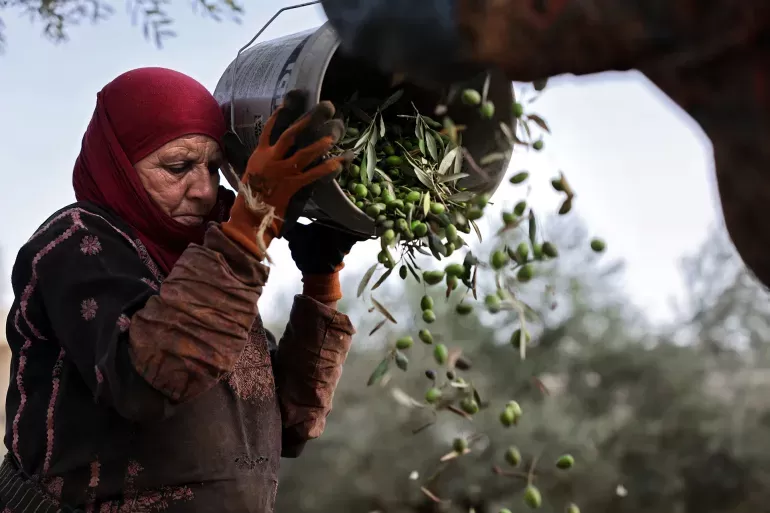
Palestinian women in the West Bank resist settlement expansion through agriculture.
Arabian Sea Newspaper - Special
**Arab Gulf - Follow-ups:** **Nine Palestinian women are performing a "great mission" in the town of Beit Ummar, north of Hebron in the southern West Bank, to preserve the land in the face of the rapidly encroaching settlement expansion. They resort to agriculture as a way to confront the settlement encroachment, considering it one of the various methods used by Palestinians in the occupied West Bank to cling to their land and protect it from attacks by the Israeli occupation army and settlers. The women's work is not limited to producing vegetables, but extends to producing other traditional foods, including tomato paste, pickles, and more.** **Wafa Abu Maryam is one of those women who have been participating together in an agricultural project for several years, but it has turned into a resistance project that stands firmly in the face of Israeli settlement expansion. The women cultivate about 5 dunams (a dunam is equivalent to one thousand square meters) with vegetables, grapes, and other crops. Next to the farm lies the Gush Etzion Israeli settlement complex. Abu Maryam seems passionate and loves what she does. She tells Anadolu Agency that she has been connected to the land and working on it for 25 years, and has been attached to it since her childhood.** **The woman has a family and children. In this context, she says: "All family members help on the land, and this is how the love of the land is planted in our souls, in addition to planting the land with vegetables and trees." She confirms that "the land has been a major source of income for the family for years, and with the intensification of the financial crisis since the start of the Israeli war of extermination in Gaza, the land has become the only source of income for my family and the families of the partners."** **The five women market the products in local markets, and they are often sold directly to consumers, but they complain about the deterioration of prices in the market compared to the requirements of agriculture and production. However, this dilemma seems like "a drop in the ocean" compared to the attacks of settlers, as Abu Maryam confirms that "the biggest challenges are the Israeli settlement expansion in the West Bank at the expense of Palestinian land." She points out that the Gush Etzion settlement has taken a large part of the Palestinians' land. Regarding Israel's decision to annex the West Bank, the Palestinian woman says: "We are living in the unknown. Every day we see the annexation being realized on the ground through settlement expansion." Expressing her adherence to the land despite the challenges, Abu Maryam continues: "Despite that, we will not leave our land and we will stay in it. There is no place for us other than this land. Today, we resist by agriculture and by staying. This farm will remain a dam in the face of settlement." She confirms this by saying: "This land, air, and water are only for us." Next to the farm is an old water well, where "settlers come to it continuously, claiming that it is a Jewish heritage, and they are tightening the screws on Palestinian farmers," according to Abu Maryam.** **For her part, Amal Salibi tells Anadolu Agency, while continuing to work on their farm, that she belongs to the land and loves it, and loves her project "even if it is economic, but it is surrounded by love and belonging to the land." Regarding the role she plays, she continues: "We are on a great mission to protect the land. We protect it with our continuous presence in it, and by cultivating and investing in it." Salibi believes that "the economy and agriculture are a pillar of steadfastness on the land in light of Israel's continued efforts to empty the land of its owners, expel them, and have settlers seize the largest area of it." She adds: "We grow beans, grapes, tomatoes, and other crops and support our families."** **At the end of last August, the Hebrew website "Walla" (private) reported, quoting unnamed private sources, that Israeli Foreign Minister Gideon Sa'ar informed his American counterpart Marco Rubio that Tel Aviv is preparing to announce the imposition of its sovereignty over the West Bank in the coming months. On Wednesday, Israeli Finance Minister Bezalel Smotrich announced Tel Aviv's intention to annex 82% of the area of the occupied West Bank to Israeli sovereignty, and stressed the need to "prevent the establishment of a Palestinian state." In preparation for annexing the occupied West Bank, since the beginning of its war of extermination on Gaza, Israel has intensified the commission of crimes in the West Bank, including demolishing homes, displacing Palestinian citizens, confiscating their lands, and expanding and accelerating settlement construction.** **Settlement expansion in the West Bank has accelerated since the start of the Israeli war of extermination in the Gaza Strip on October 7, 2023, but Israel is moving towards implementing a plan to annex the West Bank to its sovereignty, along with another plan to separate Hebron. At the end of last August, the "Israel 24" channel (private) said that Prime Minister Benjamin Netanyahu will discuss a plan to separate the city of Hebron from the area of influence of the Palestinian National Authority and replace the leaders of the region with local clans and establish a separate "emirate," in response to the intention of a number of Western countries to recognize the State of Palestine. The channel added: "This entity (Hebron after its alleged separation) is expected to recognize Israel as a Jewish state and join the Abraham Accords for normalization between Arab countries and Israel."** **In parallel with the genocide in Gaza, the Israeli army and settlers in the West Bank, including East Jerusalem, killed at least 1,017 Palestinians, injured about 7,000 others, and arrested more than 18,500, according to Palestinian data. With American support, since October 7, 2023, Israel has been committing genocide in Gaza, which has left 64,455 martyrs and 162,776 wounded Palestinians, most of them children and women, more than 9,000 missing, hundreds of thousands of displaced people, and a famine that has claimed the lives of 393 Palestinians, including 140 children.** **Source: Anadolu Agency**