

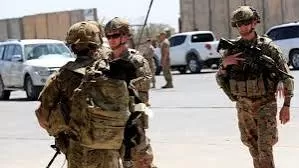
US troop withdrawal from Iraq... is there a repositioning?
Arab Sea Newspaper - Special
**Arab Gulf - Reports:** In an unexpected move, the United States of America has begun to accelerate the withdrawal of its forces from Iraq, initiating the transfer of its soldiers from the Ain al-Assad and Victoria bases to Erbil and a neighboring Arab country. This surprising step, which comes before the official date agreed upon with the Iraqi government by the end of next September, raises profound questions about the real reasons behind this sudden strategic shift, and whether it reflects a redrawing of the map of the American presence in the region. **End of the International Coalition's Mission** Officially, the mission of the international coalition in Iraq was scheduled to end by September 2025, according to the agreement between Baghdad and Washington. However, political sources confirmed that the Americans informed their Iraqi counterparts of the decision to accelerate the withdrawal and not adhere to the previous timeline. This decision opens the door to varying interpretations: Is it a response to internal American pressures? Or is it the result of regional and security developments that make the presence of American forces in Iraq more dangerous than their departure? **Growing American Concern About Terrorism** In parallel with the withdrawal step, the American embassy in Baghdad expressed grave concern about the expansion of the activities of ISIS and Al-Qaeda in the region. Washington affirmed that it will continue to strengthen its regional partnerships to combat terrorism, which raises a pivotal question: If the terrorist threat exists, why is the United States accelerating its withdrawal from Iraq? Some believe that Washington is counting on more flexible and less costly bilateral regional alliances than a direct presence on the ground, while others believe that the United States is redistributing its forces to face other more pressing challenges in the region. **Iraqi Position: ISIS is No Longer an Existential Threat** For his part, the spokesman for the Commander-in-Chief of the Iraqi Armed Forces, Sabah al-Numan, responded to American concerns, stressing that ISIS cells have become "paralyzed and do not pose a threat to Iraq." Al-Numan stressed that the Iraqi borders are fully secured, and that the army continues to pursue the remnants of the organization through precise security and intelligence operations. This position reflects a growing Iraqi confidence in the ability of the national forces to manage the security file, but it raises doubts, in return, about whether this assessment is consistent with American and international concerns. **The Popular Mobilization Forces Return to the Forefront** With the start of the American withdrawal, the draft law on the Popular Mobilization Forces (PMF) has returned to the circle of political debate. Washington believes that passing the law will strengthen Iranian influence within Iraq, and deals with it as an escalatory step that may warrant a reassessment of its security commitments. In contrast, many Iraqi forces consider that the passage of the law represents a sovereign paper that enshrines a new security reality after the departure of the international coalition. Here, the law turns into a strategic pressure tool in the power struggle between Washington and Tehran on the Iraqi scene, and puts the government in front of a complex equation between the requirements of national sovereignty and the pressures of regional balances. **Iraqi Forces are Stronger Than Ever** In his interview with "Al-Tasi'a," the advisor to the Iraqi Prime Minister, Hussein Allawi, downplayed the importance of concerns about the army's ability to face security challenges after the American withdrawal. Allawi said: "There is an attempt to exaggerate the issue, as the Iraqi armed forces today are strong, and not in the moment of the fall of Mosul or the events of 2003." He pointed out that Iraq is working with its partners in the international coalition, and with NATO, to develop its military and intelligence capabilities. He also affirmed that security priorities have changed, as drugs now rank first in the Iraqi national security strategy 2025-2030, while the threat of ISIS has become second. **From International Cooperation to Bilateral Partnerships** Allawi explained that the next stage will witness the transition of security relations between Iraq and the countries of the international coalition to bilateral relations based on strategic agreements, whether with the United States, the United Kingdom, Germany, or the countries of the European Union. He also pointed out that there is cooperation with other countries such as France, South Korea, Russia, and China in the field of armament and military training. This shift reflects Baghdad's desire to institutionalize its armed forces away from relying on a broad international coalition, and in a way that enhances the independence of the Iraqi security decision. **The ISIS Threat Between Reality and Exaggeration** Despite Allawi's acknowledgment of the existence of small pockets of the terrorist organization in scattered agricultural areas, he stressed that these remnants are under security and intelligence control, and that the Iraqi Air Force carries out precise strikes against them from time to time. He added that "the major wave of the organization between 2014 and 2017 has ended," stressing that the threat is no longer strategic as it was in the past. But in return, Washington and the United Nations rely on reports indicating the expansion of ISIS in North Africa and the transfer of its activity to other regions, which makes the danger present at the regional and perhaps global level. **Security Sector Reform and the Path of the Popular Mobilization Forces** Allawi indicated that Iraq is proceeding with reforming its security sector by institutionalizing agencies such as the National Security, National Intelligence, and the Popular Mobilization Authority, stressing that the draft law on the PMF is still in Parliament, and that the final decision on it rests with the political forces. This file may constitute a sensitive axis in the future relationship between Baghdad and Washington, especially if the Americans consider that the law opens the door wide for the growing influence of Tehran in the Iraqi arena. **Vision of the Iraqi Government** Allawi revealed that Prime Minister Mohammed Shia al-Sudani has a clear vision based on distancing Iraq from regional conflicts, and adhering to diplomacy and dialogue as an entry point to protect stability. He said: "Iraq seeks to find a new theory of regional security based on dialogue, while adhering to the protection of diplomatic missions and building the Iraqi armed forces." In this sense, it seems that Baghdad wants to balance the American withdrawal with more openness to multiple international and regional partners, while maintaining its commitments in the fight against terrorism. **Washington Between Withdrawal and Repositioning** Ultimately, it appears that accelerating the American withdrawal does not mean Washington abandoning Iraq completely, but rather reflects a strategic repositioning that allows it to reduce field burdens while maintaining political and security influence through bilateral partnerships. The withdrawal from the Ain al-Assad and Victoria bases may be a step in a broader path that redraws the map of the American presence in the Middle East, and puts Iraq before a real test of its forces' ability to manage the next stage. Accelerating the American withdrawal from Iraq poses a complex equation: Washington seeks to reduce its field commitments without losing its influence, while Baghdad affirms the readiness of its forces and puts forward a new priority for national security. But between the draft law on the Popular Mobilization Forces, the renewed threats of ISIS, and regional balances, the future of Iraq's security remains dependent on Baghdad's ability to manage its independence without slipping into a strategic vacuum that other forces may benefit from.