

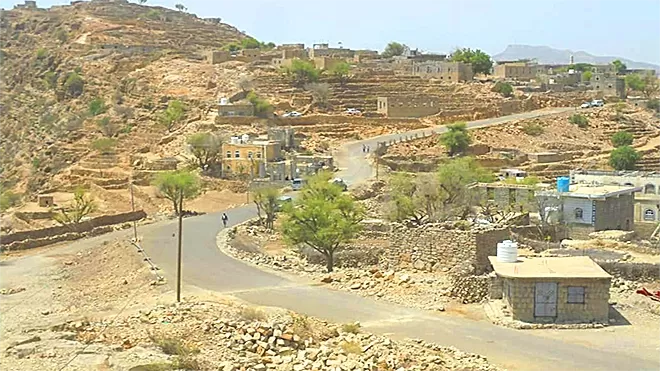
Villages dependent on rainwater... Drought exhausts the people of Jabal al-Bakri in Radfan.
Arabian Sea Newspaper - Special
Radfan ((Arabian Sea)) Hisham Ateeri: In the Jabal al-Bakri areas, or the al-Bakri phenomenon, more than 45 villages are scattered among the mountains, inhabited by thousands of people. However, these areas have been suffering from drought and a severe water crisis for many years. The residents rely on rainwater, which they store in dams or ponds to use for drinking and domestic purposes for several months, while others are forced to buy water tankers at large sums that have burdened the people in those areas. Jabal al-Bakri Areas The villages of the mountain, which are considered to be about a thousand meters above sea level, used to rely on a water project that started pumping water to those villages and is called the Sam'an water project since 1986 AD. However, this project stopped working, which increased the suffering of the people, as the project needs rehabilitation with government support or from donor agencies. Sheikh Saleh Hussein Al-Essai, Sheikh of the Al-Essai tribe in the mountain areas, said that the mountain areas are experiencing a severe water crisis and drought throughout the year, and the residents rely on rainwater. However, this year the rains were delayed due to climatic conditions, which exacerbated their suffering, and they were forced to rely on providing water through tankers, the cost of which ranges between 50 and 150 thousand Yemeni riyals. Sheikh Al-Essai pointed out that the people in the mountain areas live in poor conditions and rely on pond water for drinking and domestic uses, noting that there are many attempts to drill wells, some of which have reached a depth of 370 meters without success, which requires deepening the wells, while the people are unable to pay the drilling costs. Sheikh Al-Essai called on philanthropists, international organizations, and charitable institutions to help in drilling wells that reach depths of between 700 and 800 meters. He added that the water crisis in the mountain areas leads to great difficulties in securing water for drinking, agriculture, and daily uses. Sheikh Abdul Hakim Asaad Thabet Al-Tabaza Al-Bakri said that the land of Al-Bakri Mountain and the surrounding areas and Radfan centers are more than 25 kilometers away from the city of Al-Hubailin, and are considered rural areas that depend on rainwater. They are also rich in livestock, beekeeping, and coffee cultivation. He explained that due to the drought, the amount of livestock has decreased, and the acute water crisis has led to the displacement of some residents when the crisis intensifies. The population of the mountain is approximately 45,000 people distributed among the following centers: Al-Humaidi Center, Al-Sababa Center, Al-Mahatt Center, Aqiba Center, Dabsan Center, Ayman Center, Wahda Center, Sam'an Center, Shaabteem Center, Al-Khala Center, Jabal Hamish Center, Al-Jibla and Al-Hajib Center, and Bilad Al-Omari Center. Sheikh Abdul Hakim Asaad Thabet Al-Tabaza Al-Bakri pointed out that the Sam'an - Jabal Al-Bakri water project was established in 1986 AD in the Sam'an area, and contains three wells and three pumps, in addition to a tank in the Al-Thaila area that contains two pumps, a tank in Al-Mahatt that contains two pumps, and a tank in Al-Arqoub - Dhahrat Al-Humaidi, in addition to the Bashab Al-Dharfi tank. Sheikh Tabaza confirmed that the situation requires urgent intervention to address the current crisis by repairing the main line and restoring water pumping to the centers by rehabilitating the stalled project, calling on international organizations, businessmen, and the state to intervene to save the people from this ongoing suffering. Sheikh Tabaza continued his speech by saying: "The Sam'an water project was considered one of the strategic projects that covers the mountain areas, and work on it began in 1986 AD, and it consisted of three wells, pumping machines, and tanks. However, the project was not handed over to any official body or even a local committee, and it continued to pump water for a period, before stopping for a long time, then it returned to work again in a limited way." Ten years ago, the Sam'an water project was pumping water to the mountain areas, but it stopped due to the absence of any official body to manage it, thus ending the project that would have ended the suffering of the people in the mountain areas. This requires urgent action by the concerned authorities to find the necessary solutions and treatments to restart the Sam'an water project and end the suffering of the villages of Jabal al-Bakri. Sheikh Abdul Hakim Al-Hujaili said that the mountain areas in Radfan suffer from severe scarcity and drought in water, and its residents live in very difficult conditions due to the lack of wells or a water project that covers their needs, which threatens the people with forced displacement. He added that the interventions of philanthropists from businessmen, traders, military leaders, and the institutions of Jabal and Rawabi Radfan contributed to providing water tankers to cover the needs of most of the mountain areas and help the citizens. Sheikh Al-Hujaili explained that despite the recent moderate rainfall, citizens are still suffering from water scarcity and drought. On behalf of the people of the mountain, he called on the local council, organizations, institutions, philanthropists, and military leaders to intervene urgently to establish an integrated water project that serves all the mountain areas. For his part, Assistant Physician Malek Muthanna revealed that many people are exposed to diseases, especially kidney diseases, as a result of using uncovered water for long periods without any treatment with chlorine or cleaning materials, in addition to the low level of medical services in the mountain areas. For his part, Fadl Al-Qutaibi, Director General of Radfan District, confirmed that the mountain areas are suffering from a severe water crisis, as they depend entirely on rainwater that is stored in dams to suffice the people for long periods. He said that the delay in rainfall this year caused a severe crisis, pointing out that the local authority, in cooperation with the local community, tried to appeal to some parties to provide water and drill wells in several areas, and efforts are still ongoing. Al-Qutaibi explained that the radical solution to end the suffering lies in rehabilitating the Sam'an water project, which has been stalled for years, and which was established in 1986 AD in the Sam'an area, which has a large water reserve, pointing out that intervention to restart it exceeds the capabilities of the local authority and requires significant government support and efforts from donor agencies. Al-Qutaibi appealed to all supporting parties and organizations to intervene to revive this strategic project that serves more than 30,000 people in the mountain areas. He also pointed out that the local authority in the district made great efforts in following up with charitable institutions to drill water wells, especially in the Shaab Teem area, where studies showed the presence of groundwater, after the people succeeded in drilling a water well with self-efforts.