

Nine pieces of ancient Yemeni artifacts to be sold at auction in Britain next September.
Arab Sea Newspaper - Follow-ups
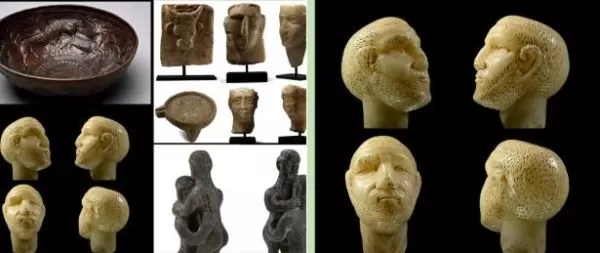
Arab Sea - Yemen - Follow-ups: Archaeology researcher Abdullah Mohsen revealed on Tuesday that nine Yemeni artifacts will be displayed in an international auction to be held in the United Kingdom next September. Mohsen said: "In some country, in some auction, to be held from September 9 to 17, 2025, many wonderful ancient artifacts will be displayed, including nine pieces of Yemeni artifacts made of bronze, marble, and limestone, dating from the sixth century BC to the second century AD. The pieces are beautiful and wonderful, like the beauty and splendor of our civilization, to which we no longer pay enough attention." He added that the pieces on display at the auction - organized by "Timeline Auctions Limited" in Essex County - date back to those periods, and include statues and heads carved from marble and limestone, decorated bronze vessels, an offering table, and even a votive statue believed to have been used in temples to atone for the sins of adultery. He confirmed that some of these pieces have been part of private German and British collections since the 1970s, and have been examined in the Interpol database of stolen works of art, but have not been registered as stolen by the Yemeni governments, with the exception of only one piece that was previously registered. He pointed out that there are efforts being made by the Yemeni Ambassador to UNESCO, Dr. Muhammad Jumeh, and his team, to register ten missing pieces from the Aden National Museum in the Interpol database, as a step towards securing legal protection for them. In describing those pieces, Mohsen said: "The beauty and splendor of these pieces is equal to the splendor of our civilization that we have neglected," calling on Yemenis to pressure the authorities to take action to stop the looting of national heritage and restore what can be restored from the country's looted history. The researcher Mohsen also described each piece in detail: The first piece: A bronze vessel from the artifacts of Yemen, dating back to the third century BC, most likely, containing a hunting scene and a prominent Musnad inscription below the inner edge, and "a prominent frieze showing a fleeing ibex being attacked by a griffin and a kneeling archer in the background; a central rosette; seven letters engraved on the inner face and four on the outer face." The griffin is a mythical animal with the body of a lion and the head and wings of an eagle, and in some conceptions it is similar to the "Sphinx" but with a human head. The vessel was part of the German Saleh collection since 1970, then later moved to a British collection. According to the auction site, it was examined in the Interpol database of stolen works of art, and is accompanied by a search certificate number 12809-241324. According to Overleet, B. and Yule, P. (2018), decorated bronze vessels were documented during the Late Pre-Islamic period, especially in the United Arab Emirates. Many of these vessels and fragments were discovered in Mleiha, and one or more pieces were found in Al-Dur, and a vessel was found in a Diba tomb dating back to the Late Pre-Islamic period. These vessels are similar to what is known as Phoenician or Levantine vessels, which were produced in the ninth and early seventh centuries BC, and combine local Levantine elements with images inspired by Mesopotamia and Egypt, and local Arab themes such as riding camels and horses. The second piece: A man's head from the late second century AD, "carved in the round with deep-set eyes and a broad aquiline nose; short hair and beard with a stippled surface design; slender neck." It was displayed at a Christie's auction, New York, on December 7, 1995, and is accompanied by an examination certificate in the Interpol database with number 12262-222127. The third piece: A marble woman's head dating back to the sixth or fourth century BC, "containing sockets to receive inlaid eyes, carved ears placed at the top, an elongated nose, the top of the head cut flat at the hairline, and the back cut roughly." The fourth piece: A marble statue of a man, from the third century BC, engraved underneath with Musnad (K L B M), "with a rectangular background, shallow cavities, ridged eyebrows, elongated nose and face, mouth defined by a straight line, large protruding ears, traces of a beard under the chin, and vertical lines representing hair." The fifth piece: A marble panel with a bull's head, from the south of the Arabian Peninsula, dating back to the third and first centuries BC, "consisting of a square panel, with lined eyes, flared nostrils, a thick tuft of hair between the eyes, and an acanthus leaf between curved horns." It was part of a British collection in the 1990s, then became part of a private collection of a businessman residing in London after 2000. The sixth piece: A marble man's head from the south of the Arabian Peninsula, probably from the third century BC, "with a small mouth raised in the middle, a large nose, deep eye sockets for eye inlay, rounded eyelids, eyebrows tapering towards the end, carved ears, the top of the head cut flat." It was also part of a British collection and then part of a businessman's collection in London. The seventh piece: A decorated marble vessel dating back to the period between the fifth and third centuries BC, "with a shallow surface, a beveled edge, and concentric circles on the inner face, with arches on two layers, and a seashell on the outer face." It was part of a private collection in the United Kingdom before 2000. The eighth piece: An offering table from the artifacts of Yemen dating back to the sixth century BC, with an unclear inscription, "with three legs distributed in the shape of the English letter D, a channel with a pouring lip, and a serrated edge." Some Phoenician letters appear in the inscription, raising doubts about its origin. The ninth piece: A votive statue with a Musnad inscription from the first century BC, weighing 380 grams, depicting a man and a woman in an intimate position. According to Dr. Faisal Al-Bard (2024), this type of statue was used as a "votive offering to atone for the sin of adultery, and is displayed in temples as a public confession of guilt, and a request for repentance." Source: Khabar News Agency