
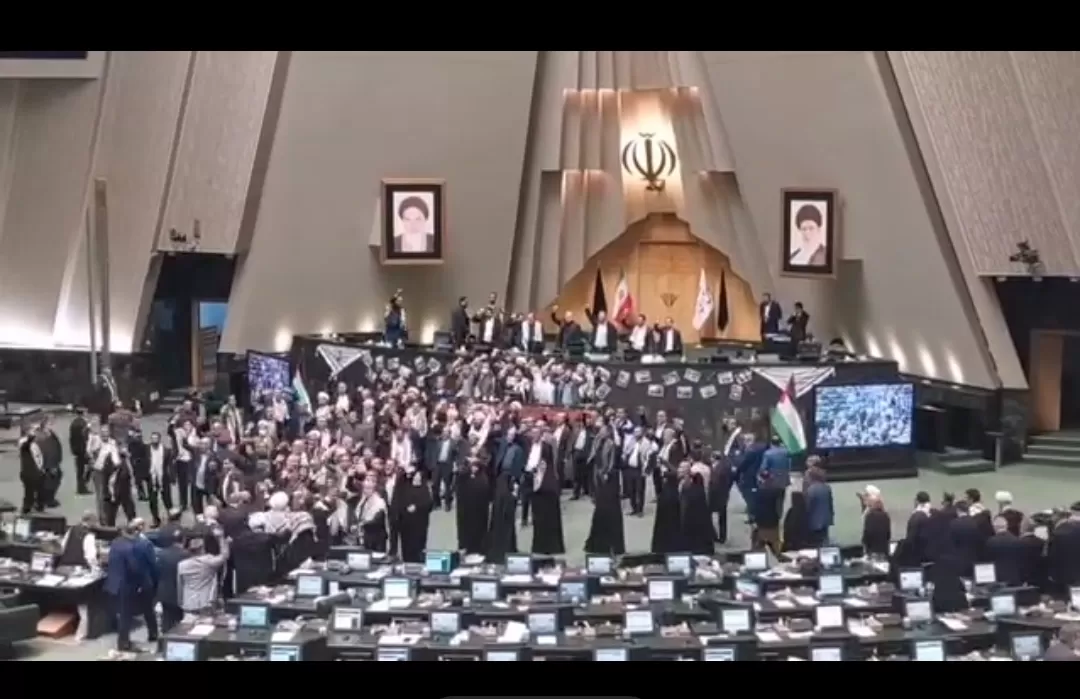
Security Council concludes vote on suspending sanctions on Iran.
Arabian Sea Newspaper - Special
**Arab Gulf - Follow-ups:** **The Security Council vote yesterday practically ended the validity of the suspension of UN sanctions that had been imposed on Iran since the 2015 nuclear agreement.** **The return of the sanctions track indicates a shift in the balance of power between Tehran and the major powers, and is a turning point that takes the Iranian nuclear file out of the circle of flexible negotiation and into a more stringent context. This development puts Iran in the face of renewed international isolation.** **The Council's halt to the extension of the suspension of sanctions is read as a sign of Tehran's declining ability to maneuver diplomatically, and the return of the specter of UN sanctions in all its weight to the scene.** **But the difference between today and before the 2015 nuclear agreement is that Iran has become more involved in regional conflicts, and more dependent on a parallel economy fed by smuggling and circumventing the international financial system.** **European diplomatic sources said that the current period has gone beyond the stage of testing intentions, and is a serious test of Iranian behavior. The sources also added, "We do not expect new speeches or soft diplomatic messages from Iran, what we need is to open the doors to the International Atomic Energy Agency without restriction or condition, and to provide accurate timetables for reducing enrichment.** **The next few days will be the judge, and if we do not see concrete steps, it will be difficult for any European capital to defend the idea of de-escalation."** **The sources added, "In internal European discussions, the idea has recently been raised that the reimposition of sanctions may not be sufficient on its own if Iran continues to escalate and procrastinate.** **There is a recognition that economic and diplomatic pressures can slow down the program, but they cannot alone dismantle the structure that Tehran has built over the past years. For this reason, talk has begun to surface about complementary options that may include limited strikes, whether through supporting American or Israeli operations or through not objecting to them politically in international forums."** **The sources elaborated on this, "The logic here is not to seek a comprehensive war, but rather what we can describe as hard messages. These operations would work in parallel with sanctions to change Tehran's calculations, especially if coupled with an international consensus that provides legitimate cover."** **Europeans are naturally hesitant about the military option, according to the sources, but Iran's failure to make real concessions in the next few days may turn this hesitation into tacit acceptance.** **The sources said: "We are not talking about an official announcement or a collective decision, but about creating a political climate that allows surgical strikes to pass if they are imposed. It is clear that any link between the continuation of enrichment above the maximum limits and the expansion of Iran's regional activities will increase the likelihood of resorting to this scenario. In this case, it can be said that Tehran will have opened the door itself to a more dangerous phase that goes beyond isolation to direct targeting."** **The European sources considered that the European bet is not only on the nuclear issue, as they are following Iran's behavior in any regional move, "Any provocative move will be considered additional evidence that Tehran does not want to de-escalate, and if Iran or its proxies target maritime supply lines, the European response will be different and more stringent."** **The main dilemma for the Europeans is that Iran believes it has enough time to repeat the game of open-ended negotiation, but what Tehran does not realize, according to the sources, is that the international environment has changed radically. The mood within European capitals is more inclined to be strict than it has been at any time since 2015. There is a growing recognition that Iran's "stalling" policy is no longer just a nuclear problem, but a source of danger to regional stability as a whole.** **The sources added, "In the coming days, the judgment will not only be at the level of technical cooperation with the International Agency, but at the level of Iran's behavior as a regional actor. If it continues to test the limits of international navigation or raises the level of tension through its proxies, Europe will see this as further evidence of the absence of any intention to de-escalate. This will open the discussion within our circles about other tools that certainly go beyond traditional economic sanctions."** **Iran lived through harsh years of international embargo before 2015, which ended with the signing of the nuclear agreement with the major powers, which gave it a temporary economic respite. But the return to sanctions at the end of this month does not only mean reproducing that stage, but rather means returning to isolation in a more complex environment. Iran today is no longer limited to its nuclear program, but it also no longer possesses the same regional influence that it built during the past decade.** **Iran's presence in Syria has faded, and in Lebanon, Hezbollah is facing increasing pressure that has weakened its traditional position as a direct representative of Tehran's will. However, Iran is still betting on its arms in Iraq, and on the capabilities of the Houthi militia in Yemen, as its last relatively influential cards in the region.** **This transformation makes it more exposed; as it has become a pressured player trying to maintain what remains of its eroding influence, and this involvement doubles its fragility; because any broad sanctions or a directed strike against it will not remain confined to the Iranian interior, but will resonate throughout the "network of influence" it has built in the region.** **Since the US withdrawal from the nuclear agreement in 2018, Iran has developed complex tools to circumvent sanctions, from hidden oil shipments destined for China, smuggling through the Gulf and through Iraq, and the use of commercial fronts and intermediary companies in East Asia. This "gray economy" provided Tehran with the minimum liquidity to maintain its political and military apparatus, but it did not modify the reality of internal erosion, according to political analyst specializing in Iranian affairs, Mohsen Zaghloul.** **Zaghloul added that with the return of UN sanctions, this economy is expected to become more difficult and more costly; as the United Nations will restore the monitoring and freezing mechanisms that were lifted after 2015; which means that the areas of circumvention will narrow, and that reliance on smuggling channels will turn from a flexible advantage to a point of weakness that can be targeted.** **The Iranian affairs analyst considered that there is a qualitative shift in the way Europeans think about the Iranian file. The traditional equation that was based on "tightened sanctions in exchange for keeping the door to negotiation open" has begun to lose its validity, to be replaced by a more solid approach that accepts the idea of mixing economic pressure with a limited military response. This does not mean that Europe is about to change its peaceful political doctrine, but it realizes, according to Zaghloul, that pressure alone has not succeeded in curbing Iranian nuclear ambition, nor in reducing its destabilizing activities in the region.** **He added that any discussion about "surgical" strikes is intended to be deterrent messages more than long-term military operations. "Such a trend reflects a desire to create a new deterrence equation by keeping sanctions as a permanent framework, while threatening to use force if Tehran crosses clear red lines."** **Researcher in Iranian affairs, Idris Ahmadi, considered that one of the direct results of the return of sanctions will be to deepen the division within the Iranian elite itself.** **At a time when the hard-line faction may press for the adoption of an open challenge discourse, there will be more pragmatic voices emphasizing that the country is unable to withstand a new cycle of isolation.** **This internal contradiction, according to Ahmadi, will make Tehran unable to produce a coherent strategy, and will increase its confusion in the face of European and UN pressure; which may accelerate the transition of the crisis from being an external file to being an internal predicament that threatens the cohesion of the political system.** **He added that the new pressures make dealing with Iran more costly for traditional or potential partners. In Iraq, for example, the government seems more inclined to reduce its economic and political dependence on Tehran under the pressure of international sanctions.** **In Lebanon, the financial exposure of the Hezbollah militia weakens Iran's attractiveness as a regional patron. This erosion leaves Tehran more isolated, and pushes local forces to look for political and economic alternatives that move away from the Iranian sphere of influence.** **He continued, "Europe today is not only talking about imposing sanctions, but about building a composite deterrence system; through crippling economic sanctions, with military threats sending decisive signals.** **This mix aims to impose a new equation, so the more Iran raises the level of enrichment or expands its regional movements, the more it will face a wider and faster range of responses.** **In other words, there is a transition from a policy of slow pressure to a policy of composite pressure; which means that the strategic environment around Iran may become more hostile than it has ever been."**