
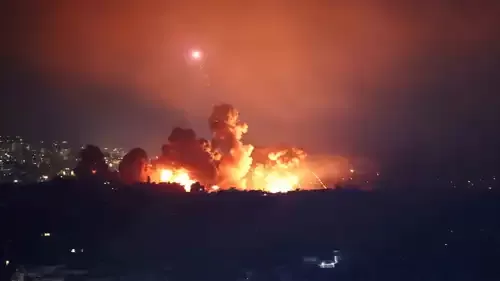
Syrian-Israeli meeting... Israel outlines the framework for dialogue with "fire".
Arabian Sea Newspaper - Special
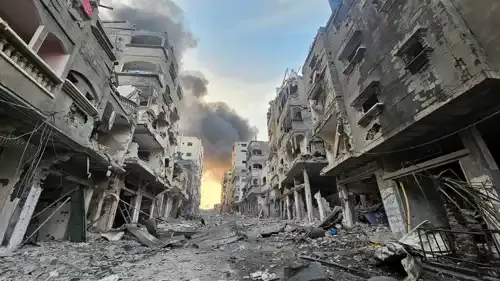
**Arab Sea - Follow-ups:** **Private Syrian sources said that the Israeli bombing, which targeted the vicinity of several Syrian cities, including Latakia, Homs, and Palmyra, goes beyond the direct military nature to carry political and security messages related to the sensitive timing; as it came before an upcoming ministerial meeting between Damascus and Tel Aviv this week.** **The sources added that the strikes were not just a field operation, but an attempt to impose a prior negotiating rhythm that enshrines Israel's presence as an active party that cannot be ignored in the equations of influence within Syria.** **They considered that this escalation is a double warning, as it restricts the options of the transitional government and its allies in strengthening their military capabilities on the one hand, and on the other hand, it sets red lines for regional mediators, especially Turkey; which reflects the continued climate of mistrust and makes the path of the upcoming dialogue fraught with concerns and tests.** **In this context, writer and political researcher Amjad Ismail Al-Agha said that the Israeli escalation and bombing that affected Homs, Latakia, and Palmyra carries many strategic and political implications that go beyond mere traditional military action, in terms of timing, pointing out that this escalation preceded an Israeli ministerial meeting with the Syrian regime, and this carries a warning and symbolic nature, aimed at emphasizing Israel's position as a force that cannot be bypassed or ignored in the equations of controlling influence within Syria.** **He added that this bombing is a coded political message that expresses the continued state of mistrust and deep reservations about any understanding that may lead to strengthening the capabilities of the Syrian regime, and Israel is trying to extend its influence on the negotiating table, and remind Damascus and the mediators, specifically Turkey, of the limits of its acceptance of any moves that reduce its security influence.** **From a strategic point of view, Al-Agha explained that the recent escalation reflects Israel's desire to preempt any attempt by the regime or its allies to strengthen the military or logistical infrastructure, especially with regard to missile capabilities, and it also reflects a broader state of strategic tension, and Israel is trying to balance influence in Syria through military operations and political messages.** **From the perspective of the transitional government, the Israeli bombing before the ministerial meeting may constitute a test of the extent of the realism of the political de-escalation and the possibility of building trust, whether between the two sides or the international guarantor parties, and thus the bombing shakes the possibilities and reinforces the state of cautious optimism, and indicates that the conflict on the ground remains the same even within the context of the upcoming diplomacy; which puts Damascus in front of a complex equation of balancing between accepting dialogue and pressure on the ground.** **Meanwhile, the human rights activist and political analyst Nidal Hori saw that the recent statements coming from Israel confirm that the ongoing battle is with Turkey, which has not learned the lesson since the previous raids on the T4 military airport in Homs, the Hama military airport, and other sites.** **He pointed out that Israel is proceeding to redraw the region after the rule of the Al-Assad family according to its plans, regardless of who accepts or rejects it, so the operation is not directed against Syria in its current form, but rather against Turkish intervention in Syria, and despite the ferocity of the bombing, it is only fiery messages, through which it confirms that it will not be drawn into a war, but will not stop addressing any file that harms it and its national security.** **Hori explained that the Israeli escalation can be understood as a smart political and military move that reflects Israel's aversion to any rapprochement with the transitional government except within conditions and controls that preserve Israeli security superiority, with a desire to impose a fait accompli that is difficult to ignore during the upcoming ministerial meeting.** **He pointed out that the recent Israeli escalation is a message of deterrence and redrawing of security borders, as the political and security game in Syria is still dependent on a volatile balance of power that is difficult to resolve.**