

Grossi Warns... What's the Story Behind the Countdown to the First Nuclear War?
Arabian Sea Newspaper - Special
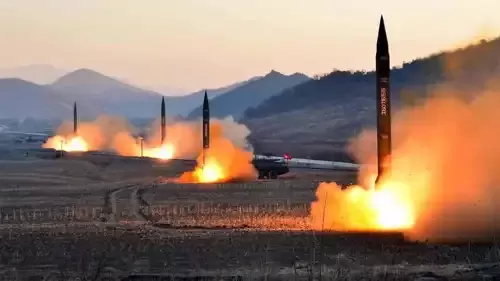
**Arab Gulf - Agencies:** Nuclear and international relations experts have expressed concerns that the world may soon reach its first nuclear war in light of the ongoing arms race in this field, with increasing risks in a world that now includes about 9 nuclear states, likely to rise to 25 nuclear powers. They explained that the world is at any time exposed to a nuclear war in light of countries boasting of their nuclear military capabilities and the rise in international nuclear armament rates. They pointed out that all scenarios are open for testing, especially with the successive developments in international interactions, particularly with regard to the European bloc and the paths of the Russian-Ukrainian war, as well as the movements in the East Asia region, and what may result from tests of the balance of power between Israel and Iran in the Middle East region. The head of the International Atomic Energy Agency (IAEA), Rafael Grossi, recently warned of a world with up to 25 nuclear-armed states, explaining that the risk of a nuclear conflict breaking out today is higher than it was in the past. Grossi pointed out that at some point, 20 to 25 countries may possess nuclear weapons, without specifying a time frame for that, noting that at present there are only nine nuclear powers, and that the process of disarmament or the organized reduction of nuclear arsenals has reached a dead end. The former head of the Nuclear Materials Authority in Egypt and air exploration expert, Abu al-Huda al-Sirafi, says that the existing international umbrella to prevent reaching this type of destructive clash is the International Atomic Energy Agency, as one of the United Nations organizations that includes most of the world's countries committed to the peaceful uses of nuclear energy, where its inspectors visit laboratories and stations in countries to verify the peacefulness of use. Al-Sirafi explained that the increase in the number of nuclear countries outside the IAEA charter comes in light of the existence of rogue states intensifying their efforts to possess a nuclear weapon, while some signatory countries threaten to withdraw from the charter due to the non-compliance of countries such as Israel with it, which gives it the freedom to enrich to produce a military nuclear weapon. He stressed that the decision to use nuclear weapons is not a simple matter, because it not only threatens the attacked countries, but also threatens the attacking countries that will not be able to avoid the resulting damage, explaining that any decision to use it is "insane," and that the matter so far is limited to threats under the name of deterrence. Al-Sirafi expressed his fears of a nuclear war breaking out at any time in light of countries boasting of their nuclear capabilities, but he pointed out that the world is still aware of the seriousness of such a deadly decision, and the proof is that after the Hiroshima and Nagasaki disasters, nuclear weapons were not used again. He added that ballistic and chemical weapons have already been used, while nuclear weapons have remained a tool of deterrence and threat only. For her part, Professor of International Relations, Iman Zahran, believes that the current political developments and international interactions have imposed many topics related to armament mechanisms, foremost of which is nuclear weapons and the extent of their legitimacy of use, in exchange for attempts to codify these tools and limit their spread. Zahran explained that although the relations between nuclear and non-nuclear states are not exactly the same, non-nuclear states are clearly seeking to develop political and technical mechanisms to monitor and manage nuclear technologies, as well as pushing for qualitative amendments to the structure of the Nuclear Non-Proliferation Treaty to make it more stringent, such as amending Article Six thereof. Zahran pointed out that among the possible ways to stop the nuclear arms race, there are prominent proposals such as American-Russian conciliation on strategic issues with nuclear dimensions, and strengthening reporting and transparency measures by countries that own nuclear weapons. She stressed the importance of delineating a qualitative approach based on harmonization between nuclear states and those nominated to possess nuclear weapons, in addition to non-nuclear states, in line with geopolitical developments and security interactions at the regional and international levels. She considered that the warnings and fears of going to a "nuclear war" in light of this race make all scenarios open for testing, especially with the successive developments in international interactions, particularly in the European bloc and the paths of the Russian-Ukrainian war, as well as the movements in East Asia, in addition to the sensitive balances between Israel and Iran in the Middle East.