

Report: Floods Expose Fragility of Roads and Infrastructure in Yemen
Arabian Sea Newspaper - Special
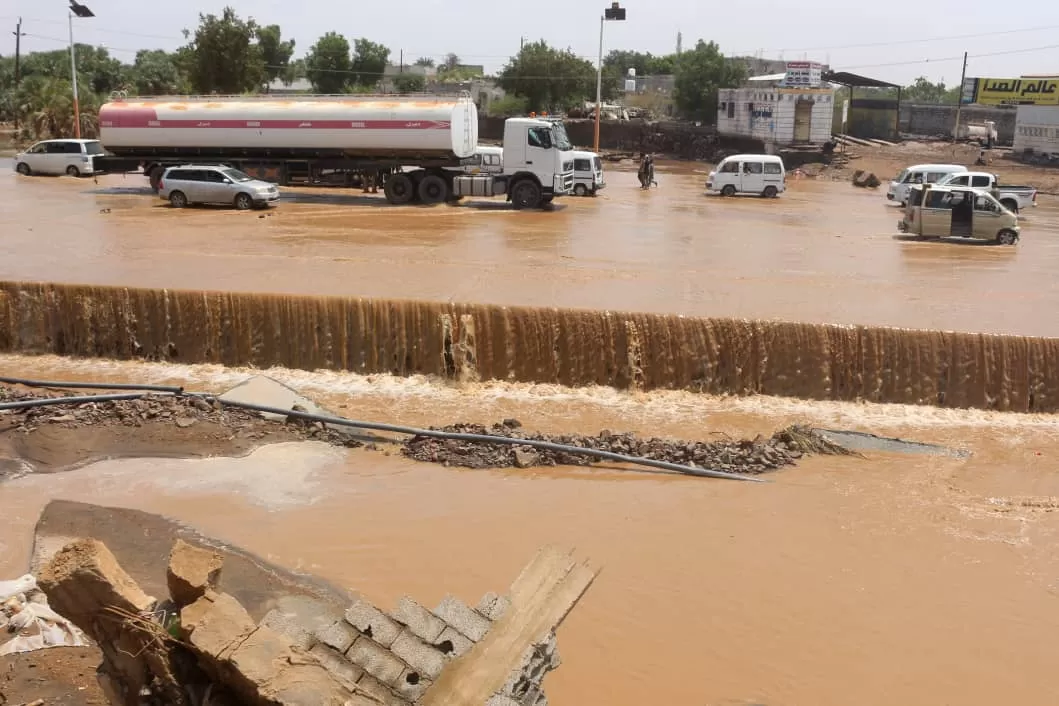
Arabian Sea - Al-Araby Al-Jadeed: The rainy season in Yemen and the flow of torrents from the mountains to the valleys reveal the fragility and weakness of the road network and infrastructure, which have also been severely damaged by the ongoing war for more than ten years, and the lack of maintenance. Since mid-August, the country has been witnessing heavy rains that have caused torrential floods in a number of governorates, affecting more than 100,000 people, according to the International Rescue Committee, and have also led to the deaths of dozens. This phenomenon recurs annually without the government taking any measures to reduce it. According to World Bank estimates, the road network in Yemen covers about 71,000 kilometers, a large proportion of which is unpaved, making movement more difficult. Abdul Wahid al-Haddad, who miraculously survived drowning with members of his family when torrents swept away his car while traveling from Aden to Taiz, told "Al-Araby Al-Jadeed": "I returned at the end of August with my family from Aden to Taiz, and I was driving my own car when I was surprised by torrential floods in the middle of the road that submerged large parts of my car and swept it away, but fortunately the floods pulled the car to the side of the road, so we were able to get out with difficulty with the help of the people of the area." The alternative road linking Taiz Governorate to Aden is one of the roads most prone to flood accidents. Since the outbreak of the war in 2015, the Houthi group has cut off the main road linking the two cities, forcing residents to use an alternative road through the city of Al-Turbah, which is a longer distance and includes rugged parts and a stream of torrents coming from the mountains and flowing into Lahj Governorate, all the way to Aden, before settling in the Arabian Sea. As the only outlet for the city of Taiz towards Aden, this road is teeming with passenger cars and trucks transporting goods, food, and supplies around the clock. In the event of torrents, the risks to travelers increase due to the few outlets to avoid the torrents. This road therefore witnesses car and truck drowning accidents annually, causing casualties. In August 2017, torrential floods resulted in the death of more than 20 people and swept away more than 15 cars and trucks. Also, Al-Haswa in Aden is one of the areas most exposed to torrential floods coming from Lahj Governorate, engulfing entire neighborhoods, destroying hundreds of homes, causing significant damage to the electricity network, sweeping away cars, and causing an unknown number of casualties. In Shabwa Governorate (south), six people died in the districts of Bayhan, Al-Talh, and Asilan, after torrents swept through valleys used as roads by a number of cars, and also destroyed roads, agricultural land, property, and cut off electricity networks. In Jabal Habashi District, west of Taiz, which is a main road for cars, the floods caused the death of a man and a child, injured others, killed animals, swept away a large number of cars, and caused significant damage to property. In the city of Tarim in Wadi Hadramaut (northeast), the depression that included Hadramaut Governorate revealed the fragility of the infrastructure and road network, after the torrents flowed and cut off roads, swept away agricultural areas, and isolated homes in Wadi Al-Ain and Hura. A young man drowned in the Al-Suwairi area of Tarim. Saif Ghaleb, a driver of a vehicle for transporting passengers between Aden and Taiz, told "Al-Araby Al-Jadeed": "During the rainy season, the risks of torrents that flow in the Al-Maqatara stream increase, especially since this flow happens suddenly and poses a danger to cars and trucks. During the rainy season, we are keen to travel in the morning, because it is safer than the last hours of the day or evening, which are more prone to rainfall and torrents." The road network in Yemen has been damaged as a result of military operations that destroyed more than 100 bridges and a third of the paved roads. These operations also closed many main roads linking the governorates, and those that remained open have been without maintenance since the beginning of the war, forcing citizens to resort to more dangerous alternative roads. Throughout Yemen, the road network has become dilapidated, exacerbating accidents due to the inability to maintain, renew, and expand it in proportion to the increasing number of users and vehicles that cross it. Most of the main roads in Yemen were built with foreign support during the seventies and eighties of the last century, which means that their lifespan has ended, and they need maintenance that has completely stopped during the years of the war. The rugged terrain is also one of the most prominent factors that negatively affect road networks, especially those that pass through valleys and rugged mountains, or sandy deserts, which exposes them to dilapidation and increases the rates of danger, especially for trucks and large vehicles. Engineer Muhammad al-Qahtani told "Al-Araby Al-Jadeed": "Most of the road network in Yemen is located in torrent streams, due to the rugged mountainous terrain and the lack of proper planning. Consequently, torrents flow from the mountains to the valleys, exposing the roads to destruction and erosion, in light of the lack of planning and engineering standards for the routes, water drainage projects, and periodic maintenance." He continues: "In addition to that, random construction in torrent streams causes major disasters, as happened recently in the Al-Haswa area of Aden."