

Economic Center: The water crisis in Taiz is a result of the absence of policies regulating the market.
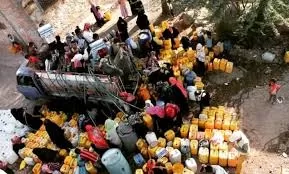
Arab Sea Newspaper - Special
Arabian Sea - Yemen - Special: A recent policy paper by the Center for Economic Studies and Media revealed that the water crisis in Taiz is no longer solely related to the scarcity of water resources, but primarily due to the absence of policies and procedures regulating the market. This has negatively impacted the ability of low-income families to access safe water at reasonable prices, amidst unprecedented prices for water tankers. The paper, titled "The Water Crisis in Taiz - An Introduction to Administrative Reform," explained that the absence of an effective administrative and regulatory framework, overlapping jurisdictions between relevant authorities, and shortcomings in legislation regulating the work of the private sector have all created an institutional vacuum that has allowed for the unregulated control of water services by the private sector. The paper presented a matrix of solutions on three tracks: urgent measures to regulate the water market and reduce exploitation, medium-term steps to re-empower the local water and sanitation corporation and strengthen its partnerships with the private sector, and a long-term strategic vision based on the foundations of sustainable governance and enhanced water security. The center called for the activation of urgent reforms to address the crisis, which has worsened during the years of war due to the deterioration of infrastructure and the weakness of government institutions, leading to the emergence of a parallel market characterized by chaos, lack of oversight, and high prices that have burdened citizens. The center affirmed that the solution requires a participatory governance model that includes the local water corporation, the General Authority for Water Resources, the local authority, the Ministry of Water and Environment, in addition to the organized private sector, civil society organizations, and donors, in order to enhance transparency and accountability and unite efforts to ensure fair, safe, and sustainable access to water. It pointed out that the paper is part of its efforts to promote economic and administrative reform and enrich public discussion about possible solutions to service crises, noting that the adoption of its recommendations by decision-makers and stakeholders will represent an important step towards alleviating the suffering of citizens and strengthening Taiz's resilience in the face of current challenges.