
What are the Houthis planning in Marib?
Arabian Sea Newspaper - Follow-ups
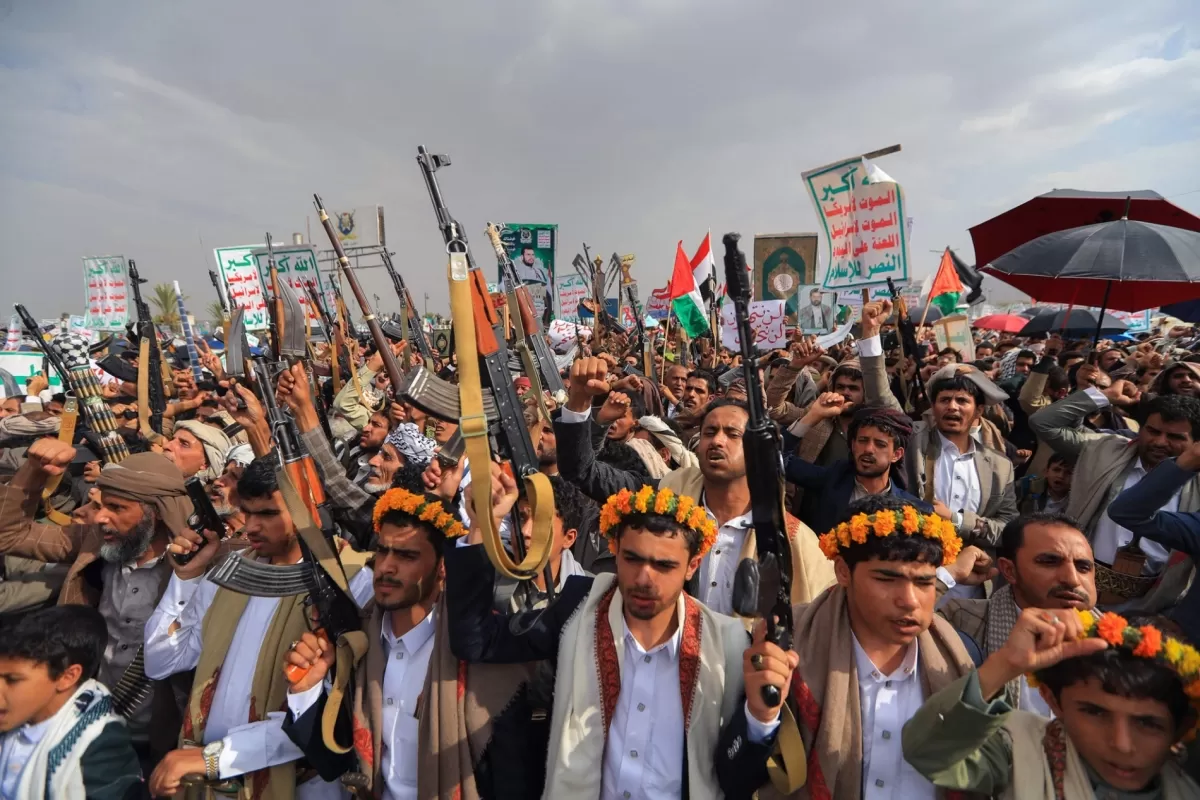
Arab Sea - The Magazine - Anwar Al-Ansi: Tirelessly, the Iranian-backed Houthi group in Yemen is engaged in opening more fronts and lines of fire with its opponents at home, and with those it describes as "countries of aggression" in the region and the world. This (phenomenon) can only be explained as conclusive evidence of the anxiety and fear that grips the group regarding what it knows or does not know is being planned for it, after its enemies have multiplied, its isolation has intensified, the economic siege imposed on it has tightened more and more, and every possible option for dialogue and peace with it has apparently fallen, due to its blind adherence to the Iranian agenda, despite the fact that no one in Yemen, the neighborhood, or the world wants to prolong the conflict with it and double the suffering of the Yemeni people and the region as a result. Calculations and Precautions The leadership of the army loyal to the legitimate Yemeni government announced in a statement this week that it considers the desert areas located between the governorates of Al-Jawf, Hadhramaut, and the outskirts of Marib a "military operations zone" in order to combat terrorism, smuggling, and sabotage. The army leadership asked citizens traveling between those areas to adhere to traveling via official roads "for their safety" and to avoid passing through secondary routes, which may expose them to danger or legal accountability. This measure came after receiving frequent reports and information about the Houthis carrying out movements, activities, and military actions, and creating roads along the lines of contact with the Marib fronts to the east, the western coast inside Al-Hudaydah Governorate, and in the governorates of Al-Dhalea and Lahj, which are adjacent to Taiz Governorate. It is true that the skirmishes and intermittent clashes between government forces and the group's militants have not stopped along those fronts, but the fragile truce in place could collapse, and the comprehensive war could return at a higher pace, and turn into a kind of resolution in any of those areas, for two reasons: The first is that the group realizes that the situation cannot last, and that one party must eventually resolve the confrontation in its favor, but the form of the expected battle has not yet become clear. Therefore, the group's fears lie in not knowing from which ambush it may be surprised. The arena is vast and the enemies are many, and therefore it is necessary to remain in a state of maximum alert, and to pretend as if preparing to face the danger from wherever it comes. Observers expect hot weeks during the coming month of September, given that most of the opposing parties have become fully prepared for a decisive contest with the Houthis, as is rumored among their leaders, and that they are only "waiting for the political decision to be taken" to begin their battle. As for the second reason that favors military resolution, military leaders and experts believe that "the end of the Houthi is inevitable," although he is "lying in wait and mobilizing every day in preparation for the battle," but the upcoming battle, in their opinion, "will be in light of and based on the results of two things. The first: the extent of the development of Iranian-Saudi relations and understandings," and the second "the future of the Iranian nuclear project" and the results of the American-Iranian meetings. Omens and Indicators Just days ago, the group's militants attacked Yemeni government forces in Saada on the "Alab" axis, where government forces killed 27 Houthis, while its forces lost 11 soldiers, according to a report by the Saudi newspaper "Asharq Al-Awsat." According to military experts, the Houthis are planning to launch attacks on several axes targeting, primarily, besieging both the rich and strategic oil city of Marib, by circumventing it from the south of the governorate, and the Al-Abr desert near the Saudi Al-Wadiah crossing, as well as regaining full control of the city of Taiz in the center of the country, by circumventing it from the governorates of Lahj and Al-Dhalea in the south, and even Al-Hudaydah in the west. But the Houthis' hopes for the fall of Marib and Taiz may not be realized as they wish, as the security and military conditions in all those areas and cities are no longer as they were in the past, when the Houthis tried to invade and control them. Moreover, everyone in the areas outside their control has prepared on the ground enough for the confrontation, even if the conditions of the battle have not yet been completed politically and even militarily. Scenarios of the Houthis' Battles With the exception of that well-known pattern of guerrilla warfare, the first and largest Houthi attack, well-planned and semi-regular, with the field participation of experts from the Iranian "Revolutionary Guard" and the Lebanese "Hezbollah," was the one launched by the group on the city of Marib in November 2021. This attack was incited by the former Secretary-General of "Hezbollah," Hassan Nasrallah, who said in a televised speech: "The fall of Marib means that the Houthis have won the war." However, the Houthi group faced fierce resistance from the tribes of Marib, and what remained at that time of the army forces, in addition to air support from the coalition forces led by Saudi Arabia, where the attack on Marib was thwarted, and the group suffered a military defeat on the outskirts of the city, resulting in the death of 27,000 of its militants, according to government military data, while the group only admitted to the fall of 14,000, unconcerned about the enormity of this number as well. How the Houthis Fight The group usually deliberately mobilizes the largest possible number of its militants, most of whom it throws into battle without adequate preparation or training, where it pushes them to fight through several successive formations that almost resemble or largely replicate Iran's experience in its war with Saddam Hussein's Iraq in the 1980s. The first of those formations is direct and close to the lines of contact, and usually consists of novice, young fighters who pay the highest price in every confrontation with their lives, and their mission is limited to depleting and exhausting the "enemy," so that the second formation begins its attack, with heavy artillery shelling, using heavy weapons and drones, and a rapid advance towards the (enemies') positions, in order to secure the arrival of the (elite) third formation to take over those positions. However, the group's "tactics" remain subject to modification and change, depending on the circumstances of the confrontation, but in every area it is forced to withdraw from, it plants thousands of mines in random ways and without maps, including anti-personnel and anti-armor mines, and others like small and large stones commensurate with the geographical nature of the area, and even in the form of dolls and children's toys, and so on. The Houthis, as many in the Middle East and around the world have come to see them, are a complex mix of a "war project" that they boast of belonging to, and cannot bear to live and feel safe without, and an armed sectarian group that, in the opinion of many members of the (Zaidi) sect, has deviated from its sect, and gone far in its loyalty to the "Imam of the End Times" and his deputy on earth, the "Guardian Jurist" in Tehran. Therefore, it is clearly loyal "ideologically and spiritually" to Tehran, and a reliable ally of it politically and militarily, meaning that it is a coordinated tactical program for Iran, and separate from its close national and Arab environment. Balance of Power We know that Iran has long supplied the group with what can be considered today a "self-propulsion force" that it relies on to wage its wars, in terms of weapons and the ability to manufacture missile weapons and drones, and some experience in human mobilization, organization, and management. But to what extent does the group know that missiles and drones alone cannot make the difference, or resolve any battle, if its opponents use their armed human energies, which are automatically mobilized against them? In the past few days, Sana'a and its suburbs witnessed a massive and unprecedented funeral for two sheikhs from its tribesmen (Naji Jumaan and Zaid Abu Ali), who were leaders and supporters of the "General People's Congress Party" founded by the late President Ali Abdullah Saleh, who was killed by the Houthis. In the funeral ceremonies, many read clear messages and indications of the exhaustion of the Yemeni tribes' patience with the Houthis, and that what "remains of their energy to bear their harm and misconduct is only the least," as some of them told me. War and summoning and bringing enmities seem to be a "nature" in the psychology of armed (ideological) groups, which do not see peace as being in their interest, nor as a source of livelihood for their fighters, but rather see it as a source that threatens their existence and future. Therefore, they deliberately use "provocation" as a means of drawing attention to themselves and gaining recognition. Since the Houthi group seized power in Sana'a, it has not stopped using this mechanism in dealing with its surroundings and those around it. In less than half a year after invading the Yemeni capital, Sana'a, the Houthi group conducted military maneuvers in the Al-Buqa area in Saada Governorate, northern Yemen, near the Saudi border, at a deliberately timed time coinciding with a meeting of foreign ministers of the Gulf Cooperation Council countries, in the Saudi capital, Riyadh, to discuss the situation in Yemen. The last "provocative" military