

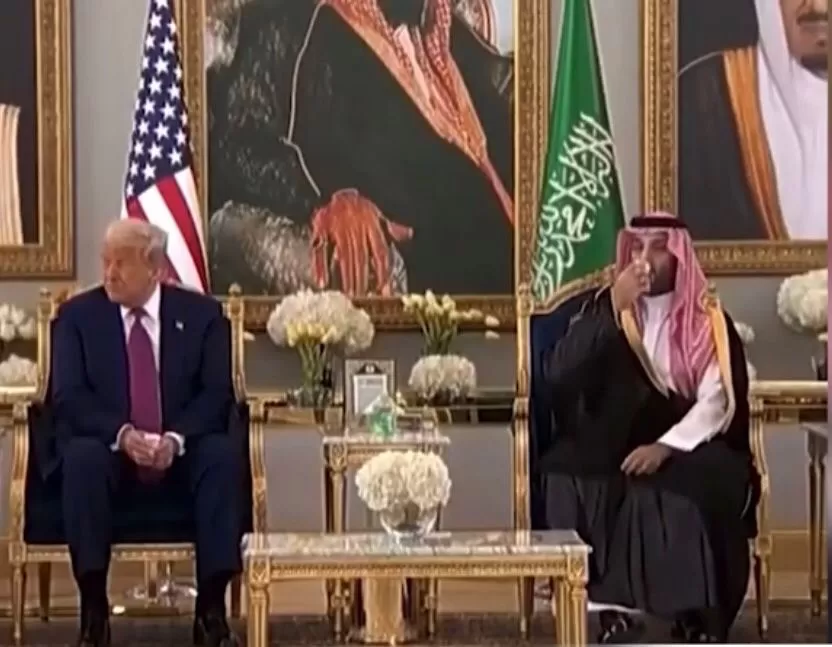
Trump returns to the Middle East via Saudi Arabia.
Trump returns to the Middle East via Saudi Arabia.
Arabian Sea - Special
Trump Returns to the Middle East via Saudi Arabia: Hundreds of Billions in Deals and a Systematic Ignoring of Hot Issues In a calculated return to the Middle Eastern stage, US President Donald Trump opened his Gulf tour from Riyadh, delivering a dual message: massive investment promises and a clear disregard for the burning files plaguing the region. While he received a royal welcome reflecting the strong historical relationship between the two countries, the visit is not without profound implications regarding the bold pragmatic shift adopted by Washington, at the expense of the values it has long championed. A Program Filled with Symbolism and Implicit Messages Trump arrived in Riyadh on Tuesday, May 13, 2025, where Crown Prince Mohammed bin Salman was at the forefront of those welcoming him. The absence of King Salman from the reception ceremony was striking, opening the door to interpretation regarding the symbolism of attendance and the reality of decision-making centers in the Kingdom. The US president participated in the Saudi-American Investment Forum and delivered a speech about the "amazing opportunities" in the region, ignoring any mention of the wars and divisions consuming its people. This was followed by an official luncheon that brought together a select group of businessmen from both sides, including Elon Musk and Jeff Bezos, and the day concluded with a royal dinner in the historical Diriyah region, reflecting politically charged messages laden with symbolism and prestige. Money Before Principles: Deals Dominate the Scene Trump announced an unprecedented package of Saudi investments in the United States, exceeding $600 billion, focusing on defense, technology, artificial intelligence, and infrastructure. Among the most prominent announcements: * A massive arms deal worth $142 billion, raising questions about priorities in a region suffering from escalating crises. * Investments of $20 billion to establish large data centers for artificial intelligence within the United States. * Agreements with major technology companies such as Google, Oracle, and Nvidia, reflecting a shift in the relationship from a security alliance to a technological and economic partnership. But the essential question is: Who is the real beneficiary of these deals? Has Saudi Arabia become a financing bank for American projects, or is it seeking to build a foothold in the race to control the future of global technology? Political Transformations Conditioned by Profits In a surprising move, Trump announced the lifting of US sanctions on Syria for the first time since 1979, paving the way for an expected meeting with the new Syrian president, Ahmed Al-Sharif, who took power after the overthrow of Bashar al-Assad in 2024. Trump also sent a direct message to Tehran, calling on it to abandon its nuclear ambitions and hinting at reactivating the "maximum pressure" policy in case of evasion. However, it is noteworthy that these statements came from an economic platform, not a political podium, reflecting the decline of traditional diplomacy in favor of market logic. Strategic Reading: Deals Without a Moral Compass Trump's visit reflects a new direction in American policy: major deals, massive media coverage, and high moral costs. Democratic values and human rights are no longer part of the official discourse, but are set aside when it comes to economic gains. While Saudi Arabia is highlighted as a key investment partner, the major strategic responsibility lies in how these investments are used to build genuine regional stability, rather than becoming mere polishing tools in an equation where humans are absent. The Absence of Israel: A Temporary Void or the Beginning of a Transformation? The notable aspect of the tour is the complete disregard for Israel, despite the ongoing military escalation in Gaza. This absence could be interpreted as a sign of strained relations between the Trump administration and the current Israeli government, or as an opportunity for Saudi Arabia to enhance its position as a regional balancing force, away from traditional polarizations. However, ignoring the Palestinian issue in this visit, despite its sensitivity, also reflects a rearrangement of American priorities, where absolute priority is given to economic interests over issues of peace and justice. Yemen: The Chronic Absentee Despite the weight of the Yemeni file, it was completely absent from the visit's agenda, which perpetuates a long-standing American approach to dealing with Yemen as a "marginal file" that is only opened when strategically necessary. Although the announced investments may later open opportunities for reconstruction, the absence of any political or humanitarian mention of the Yemeni crisis sends a worrying message about the continued international disregard for the suffering of an entire people. Conclusion: Is This Visit a Declaration of the Beginning of a "New Middle East"? From the gateway of Riyadh, Trump returns to the region with a clear approach: profits before principles, and deals before rights. The visit highlights Saudi Arabia as the cornerstone in engineering the next phase, but it also places the Arab world before an existential question: What is the value of these economic partnerships if fundamental issues—like Yemen, Palestine, and Syria—remain outside the real calculations? It is a new scene being drawn, but with old tools: interests first, and the rest is postponed until further notice.