

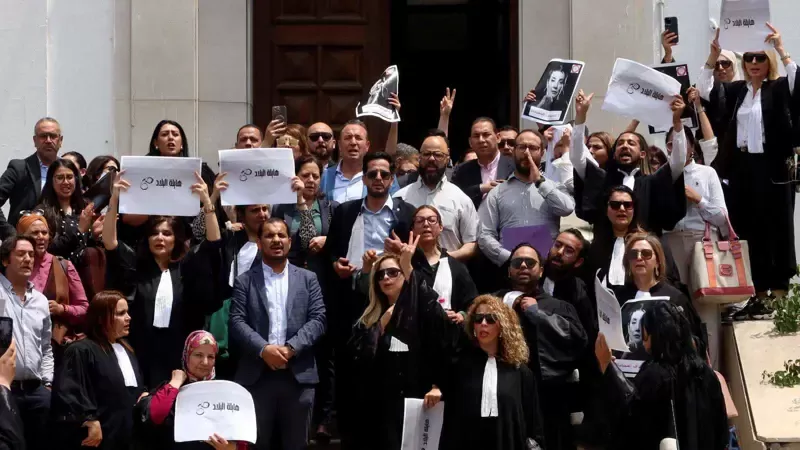
Harsh sentences against opponents in Tunisia spark controversy after the release of Dahmani.
Arab Sea Newspaper - Follow-ups:
Tunisia is witnessing a state of controversy following the release of prominent lawyer Sonia Dahmani, in contrast to the issuance of severe judicial sentences against a number of opponents accused in the "conspiracy against state security" case, reaching up to 45 years in prison. The sentences ranged from 35 years for prominent businessman Khayyam Turki, to 20 years each for Jawhar Ben Mbarek, Issam Chebbi, Chaima Issa, Ghazi Chaouachi, and Ahmed Najib Chebbi 12 years, sentences that opposition forces were quick to condemn. A number of defendants in this case who are imprisoned are on hunger strike, such as the leader of the National Salvation Front, Jawhar Ben Mbarek, who denounces what he describes as his "arbitrary detention," while the Tunisian authorities deny this and say that they tried to disrupt public order and security. In contrast, lawyer Ayachi Hammami was sentenced to 5 years in prison, while President Kais Saied condemned foreign interference in his country's affairs, after the European Parliament voted on a resolution calling for the release of activists detained in Tunisia and expressing concern about the reality of freedoms in the country. Tunisian lawyer and political analyst, Fathi Al-Jamousi, commented on the matter, saying that "the files that the Tunisian judiciary is investigating are complex files, so each file must be evaluated separately. For example, the sentences that were previously issued against Sonia Dahmani were harsh; therefore, her release is an important step." Al-Jamousi added, "The file of conspiracy against state security includes defendants who are directly involved, and there are suspicions about these people receiving huge foreign funds, and some of them have been proven not to be directly involved, and that is why we saw that the case was not heard against many of the defendants in the appeal session." He pointed out that "the conspiracy file is closed today, and another complex file will remain, which is the Instalingo file, which the judiciary is trying to decide on, and politically I believe that this stage must be overcome and a new normal stage must be launched in which people regain their freedom in the country, while preserving the strong state that is above all consideration." These developments come at a time when relations between the opposition in Tunisia and the authorities have reached a near-breakdown, while the country is also witnessing an escalation between the government and the UGTT. Tunisian political analyst, Mohamed Saleh Al-Obeidi, said that "these rulings and developments can only lead to a deepening of the gap between the opposition forces and the authorities, especially since each party is marketing what is happening as a victory for it." Al-Obeidi explained that "these developments raise fears of a possible new escalation between the two parties; because the opposition has no options left, despite the external pressure on the authorities to end the political deadlock that the country is experiencing."