
News Analysis - Moscow
Rashad Al-Alimi's Visit to Moscow... Between Messages of Sovereignty and the Reality of Dependence
Arabian Sea Newspaper - Political Analysis Section
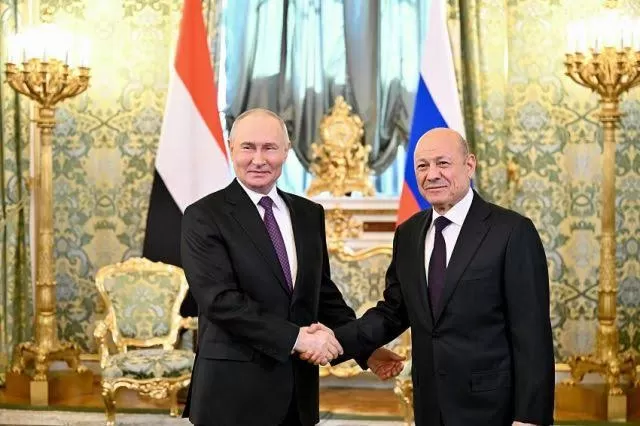
Rashaad al-Alimi's Visit to Moscow... Between Messages of Sovereignty and the Reality of Subordination Bahr al-Arab Newspaper - Political Analysis Department Prepared by: The Editorial Team Analytical Introduction: In a highly complex regional moment, and with the intensification of transformations in the Yemeni arena, the so-called Chairman of the Presidential Leadership Council, Rashaad al-Alimi, was a guest in the Russian capital, Moscow, on a visit that carries more symbolism than the details of the official statements reflect. In the corridors of the Kremlin, al-Alimi sat with President Vladimir Putin, not as the leader of a state with absolute sovereignty, but as a representative of a political entity suspended in the space of regional conflicts and international balances. So, what are the implications of this visit? What messages did al-Alimi carry in his pocket? And does it represent a step towards restoring the independent Yemeni role, or just a repositioning in the sphere of influence of the Saudis-Emiratis? Chronological Sequence of the Visit: Meetings and Messages - Monday, May 27, 2025: Al-Alimi arrived in Moscow at the head of a presidential and ministerial delegation, on an official visit described as "in response to a Russian invitation." - Tuesday, May 28: He met with Russian President Vladimir Putin in the Kremlin, in a rare meeting that gives diplomatic weight to a president who suffers from weak actual recognition internally. - The visit also included meetings with Russian Foreign Minister Sergei Lavrov, and a number of senior foreign and defense officials. The official statements sufficed to emphasize "the depth of relations" and "Moscow's desire for peace," while Putin's language seemed more balanced, urging al-Alimi to engage in "a comprehensive Yemeni-Yemeni dialogue," which reflects Moscow's awareness of the complexity of the Yemeni scene and the multiplicity of actors in it. The Content of the Interview on RT Channel: Verbal Presence... and Absence of Vision? In an interview with the Russian RT channel, al-Alimi tried to export a "sovereign presidential" discourse, stressing that his visit to Moscow stems from an independent decision, and aims to open new channels with the major international powers. But what is remarkable is that the interview was devoid of any firm stance towards the foreign military presence on the Yemeni coasts and islands, and also ignored the explicit reference to the Emirati-Saudi role, contenting himself with attacking the Houthis as "agents of Iran." This duality opened the door to real questions: Can the man represent an independent state when he is unable to name the forces that are running the scene from behind the scenes? The Meeting with Putin: Symbolism of the Image or Content of the Position? The meeting with Putin is not a passing detail. The Russian president does not receive any official easily, and his appearance alongside al-Alimi is an implicit signal of Moscow's official recognition of the legitimacy of the Leadership Council, or at least, the Kremlin's desire to keep communication channels open with all parties to the conflict. But the image alone does not make politics. Moscow, although it has shown openness, still considers the Houthis a legitimate party in the Yemeni equation, and maintains continuous communication with them, driven by geopolitical considerations and strategic interests in Bab al-Mandab and the Horn of Africa. Between the Required Sovereignty and the Existing Subordination Al-Alimi tries to present himself as a balanced figure, open to the East and the West, and ready to build partnerships outside the circle of foreign tutelage. But the reality on the ground imposes itself. The man still derives his political legitimacy from Saudi-Emirati support, and his government is seen as an authority in exile, far from the real popular and national fabric. The visit to Moscow may be a step in the direction of diplomatic repositioning, but it does not yet represent a strategic shift. The distance is still far between the sovereign discourse that al-Alimi is marketing, and the reality of complete subordination to Riyadh and Abu Dhabi, which was reflected in his silence on the direct occupation of some Yemeni islands and ports. Reading into the Results: A Missed Opportunity or a Foundation for a Path? Al-Alimi may be credited with his boldness in knocking on new doors, but the success of this visit remains dependent on two things: 1- The ability to translate Russian openness into an actual political partnership that serves the interests of the Yemenis, not the interests of the financiers. 2- Freedom from the constraints of external dictates, by creating a real balance between the inside and the outside, and not being content with playing the role of mediator between the interests of others on the land of Yemen. Conclusion: Moscow as an Open Question... Not a Final Answer Al-Alimi's visit to Moscow is not a passing event, but it is also not a historical turning point unless it is followed by bold steps that restore the Yemeni decision to its owners. The man has sent sovereign messages, but he is still surrounded by walls of subordination, and between speech and silence lies the truth of the distance between Moscow and Sana'a. In the end, the value of visits is not measured by the warmth of the reception, but by the extent of the leader's ability to transform the diplomatic moment into a real sovereign asset. So, will al-Alimi do it? Or will Moscow remain a passing station in a long journey of dependency? Which is what we expect.