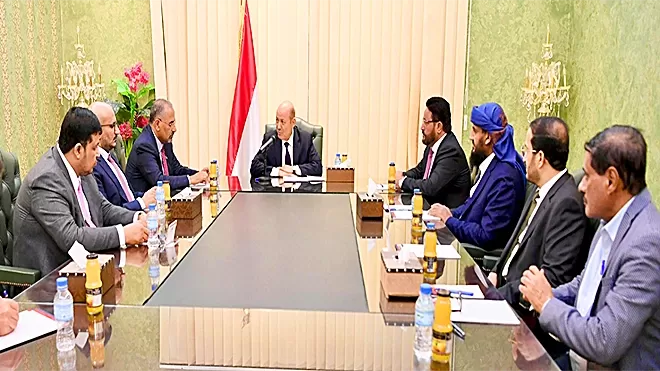


The corridors of the Presidential Leadership Council are witnessing escalating tension that has begun to exceed the limits of political backrooms and turn into an open conflict between its most prominent members, the Council's Chairman, Dr. Rashad Al-Alimi, and Brigadier General Tariq Mohammed Abdullah Saleh, a member of the Council and leader of the Political Bureau of the National Resistance.
According to a recent analytical paper issued by the Mocha Center for Strategic Studies, the current crisis is no longer limited to differences in visions, but represents a real threat to the unity of the legitimate leadership and the course of the political process in the country.
The paper, entitled "Causes and Repercussions of the Tension between President Al-Alimi and Brigadier General Tariq Saleh," considered that the statement issued by the Political Bureau on June 23, which spoke of "political exclusion" and "discrimination against partners," represented a pivotal moment in the transition of disputes from secret to public, revealing the extent of the differences that have been plaguing the Council for some time.
The analysis attributes the roots of this tension to a fierce power struggle between the two sides, mainly revolving around control of resources and the distribution of vital positions within the state. Each party seeks to consolidate its presence within the institutions of power, ensuring it an influential position in the political scene. This competition was clearly evident through the development projects led by Tariq Saleh in Taiz and Hodeidah, which some see as exceeding the size and impact of the government's own projects, which aroused the resentment of parties within the Council who see this expansion as a threat to its balances.
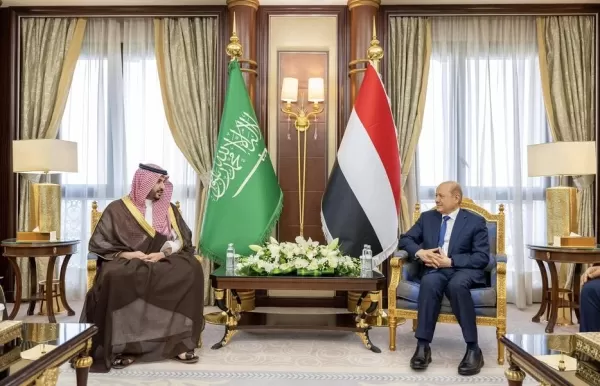
Clear regional dimensions intersect in this conflict, as the paper indicates that Al-Alimi is considered closer to the Kingdom of Saudi Arabia, while Tariq Saleh enjoys increasing Emirati support, which reflects a state of division in the regional vision for the future of Yemen, and in turn affects the decisions of the Presidential Council and its internal cohesion. This divergent association leads to disagreements over the order of political and security priorities, and complicates the implementation of the supposed agreements.
The paper points out that the lack of institutional transparency within the Council, and its lack of a clear mechanism for power-sharing, has contributed to the exacerbation of the crisis. It seems that the non-declaration of the internal regulations governing the work of the Council, and the delay in deciding on appointments related to the Political Bureau, pushed the crisis into the open, especially with the feeling of some parties of marginalization and exceeding the initial understandings on which the formation of the Council was based.
What exacerbates this disparity, according to the analysis, is the escalation of living and security crises in the liberated governorates, which reveals the fragility of government performance and deepens feelings of frustration, and opens the way for each party to hold the other responsible for failure, instead of joining forces to address the deteriorating situation.
The potential repercussions of this tension are not limited to the Council itself, but extend to the entire Yemeni scene. The paper warns that the continued division within the state leadership may hinder efforts to restore state institutions and weaken the legitimacy's position in the face of the Houthi group, especially in the absence of a unified position capable of negotiating or military resolution. It may also lead to a decline in international support, if the international community feels that the Yemeni leadership is unable to manage the state effectively or move towards a political settlement.
The paper goes on to warn that this division may weaken the national front against the coup, and open the way for separatist or regional projects that exploit the current fragmentation. The Houthi group may also benefit from this weakness to strengthen its positions or to negotiate directly with regional parties, bypassing the Presidential Council, which deepens the state of division and undermines the idea of a unified state.
On the other hand, the continuation of quotas and the struggle for influence within the Council weakens the possibility of building effective state institutions, capable of providing services and consolidating the principle of accountability and good governance. With the absence of competence and the dominance of loyalties, state institutions seem to be at the mercy of the wind, unable to achieve the aspirations of citizens or save the country from its accumulated crises.
The analysis concludes with an urgent call to reconsider the performance of the Council and the need for urgent intervention to address the roots of the dispute, not through temporary settlements or the distribution of positions, but through restructuring the Council's working mechanisms and building real institutions that transcend the logic of quotas, and put the interest of Yemen above political and individual calculations. Without this, the current dispute may turn into a prelude to a comprehensive collapse in the structure of legitimate authority, and lead the country to further fragmentation and chaos.