

Developments in the Israeli Aggression Against Yemen
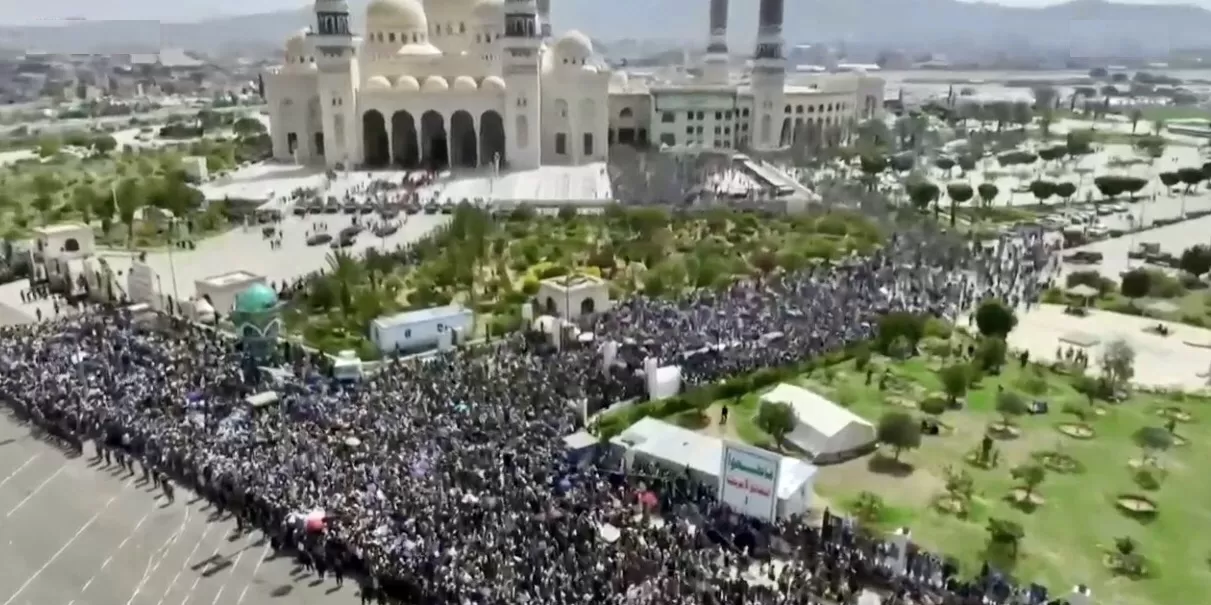
Major funeral for Houthi leaders in Sanaa after the Israeli raid.
Arab Sea Newspaper - Special
A major funeral for Houthi leaders in Sanaa after the Israeli raid The Yemeni capital, Sanaa, witnessed this morning, Monday, September 1, 2025, an unprecedented mass funeral for a number of prominent leaders of the Houthi group, led by the head of the group's government, Ahmed Ghaleb Al-Rahwi, and a number of his ministers, who were killed in the Israeli air raid that targeted a government building in Sanaa days ago. Huge crowds of the group's supporters flocked to Al-Sabeen Square in the center of the capital, in a scene characterized by popular and military momentum; where green flags and banners were raised denouncing Israel and the United States, and calling for revenge. A number of the group's leaders delivered sharp political speeches, stressing that "the blood of the martyrs will not be shed in vain," in a clear indication of the Houthis' readiness to expand the circle of retaliation. On the other hand, Muhammad Ahmed Muftah, temporarily assigned to the duties of Prime Minister, announced strict security measures inside the capital, including the redeployment of the group's forces and tightening control over government institutions, in an attempt to control the internal situation and prevent any administrative or security vacuum. Dimensions and implications This funeral comes at a sensitive time, as the group is trying to turn the event from just a leadership loss into a platform for mass mobilization. The size of the popular attendance and the raising of "revenge" slogans carry a double message: • Internally: The group aims to strengthen cohesion among its supporters after the painful blow that targeted the head of government. • Externally: It wants to send a message of defiance to Israel and its regional allies that escalation will not weaken it, but will push it to further engage in the regional conflict. Strategic glimpse This funeral is not read as just a funeral event, but as an organized show of force aimed at reproducing the image of the Houthis as a steadfast force capable of mobilizing the street in a moment of crisis. Its repercussions are likely to turn into a field escalation, whether through the Red Sea front or through new targeting of Israel's allies in the region. It is a pivotal moment, as the Houthis seek to establish a narrative that "raids do not break them," but rather give them the legitimacy of resistance, which may push the conflict to a regional dimension that goes beyond the borders of Yemen, and puts the region in front of a more fragile and turbulent stage.