

Iraq discovers 40 ancient coffins after water levels drop at the country's largest dam.
Arab Sea Newspaper - Special
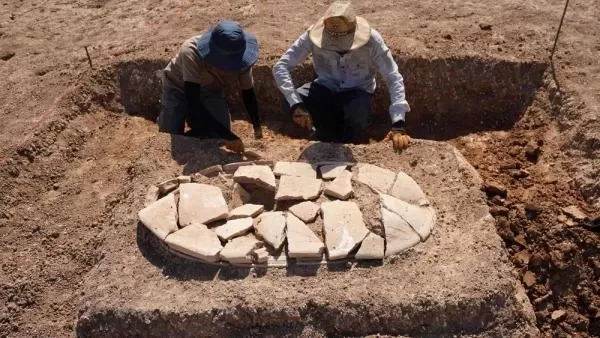
**Arab Gulf - Follow-ups:** Archaeologists in Iraq have discovered clay coffins believed to be over 2,300 years old, due to the drop in water levels in the country's largest dam, which is suffering from drought, according to an official on Saturday evening. Authorities have warned that Iraq has experienced one of the driest years in its history since 1933, and that the water reserve in dams and reservoirs has decreased to 8% of storage capacity. Archaeologists in Iraq have discovered clay coffins that may be more than 2,300 years old. The Director of Antiquities and Heritage in Dohuk Governorate, northern Iraq, Bix Brefkani, stated: "So far, we have discovered about 40 clay coffins, all buried in one direction" on the outskirts of the Mosul Dam in the town of Khanke in Dohuk Governorate, northern Iraq. An expert from the Directorate of Antiquities and Heritage in Dohuk Governorate, northern Iraq, works around an ancient clay coffin discovered on the edge of the Mosul Dam in the town of Khanke. Archaeologists in Iraq have discovered clay coffins that may be more than 2,300 years old. The Director of Antiquities and Heritage in Dohuk Governorate, northern Iraq, Bix Brefkani, stated: "So far, we have discovered about 40 clay coffins, all buried in one direction" on the outskirts of the Mosul Dam in the town of Khanke in Dohuk Governorate, northern Iraq. Thousands of years old artifacts Brefkani, who leads the archaeological research at the site, pointed out that his team surveyed the site in 2023, where they found "archaeological and pottery finds and statues, but only a few parts of them were visible because the water level was high" at the time. His team was unable to start work on this site until "this year after the water level dropped to its lowest." In addition, in recent years, archaeologists have discovered artifacts thousands of years old in the same area, following the drought that has hit Iraq for five consecutive years. "One man's misfortune is another man's fortune" Brefkani confirmed that the drought "had a great impact on agriculture, for example, but for us as archaeologists it was important to be able to excavate this site." He also explained that the discovered artifacts, which are believed to date back to the Hellenistic Seleucid era about 2,300 years ago, "will be transferred to the Dohuk National Museum for preservation and study" before the dam's waters flood the area again. For its part, the authorities said that Iraq has witnessed one of the driest years in its history since 1933 and that the water reserve in dams and reservoirs has decreased to 8% of the storage capacity. It is noteworthy that the temperature exceeds 50 degrees during the summer in a country that the United Nations considers to be one of the countries most affected by some aspects of climate change, which is reflected in a decrease in the percentage of precipitation and a rise in temperatures and contributes to exacerbating water evaporation. For its part, the Baghdad government regularly condemns the construction by the neighbors Turkey and Iran of dams on the water bodies that it shares with each of them, accusing them of significantly reducing the flow of the Tigris and Euphrates rivers when they reach Iraqi territory.