


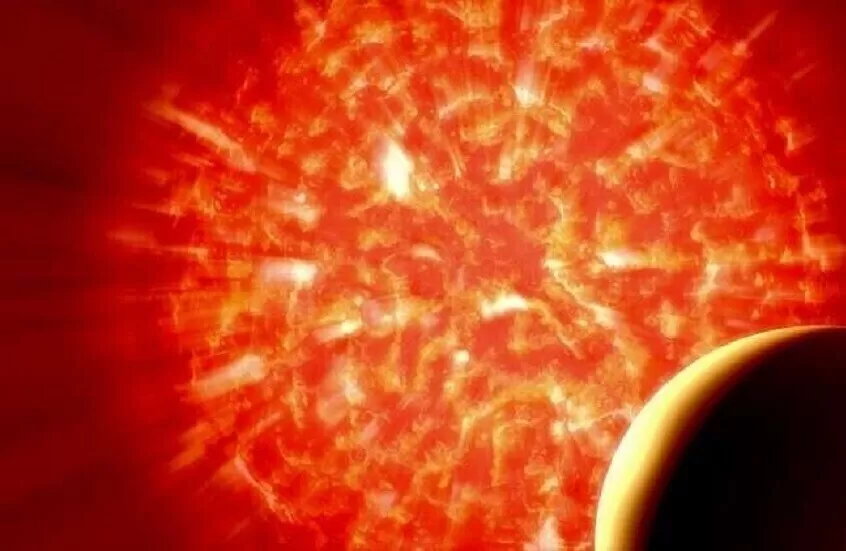
Determining the timing of the expected peak of the magnetic storm this month.
Arab Sea Newspaper - Special
Arab Sea - Follow-ups: The Solar Astronomy Laboratory of the Space Research Institute of the Russian Academy of Sciences reported that geomagnetic disturbances caused by plasma emitted from the sun will continue on Earth for 30-45 hours. According to laboratory experts, strong magnetic storms are likely to occur, peaking on Tuesday, September 2. It is reported that scientists observed two plasma emissions from the sun and a strong flare. According to them, in the first case, a medium-sized plasma cloud was launched towards Mercury and Venus, and in the second case - it headed directly towards Earth. The laboratory said in a statement: "Based on calculations of the movement of plasma emission, geomagnetic disturbances are expected on September 1 and 2 (Monday to Tuesday). According to these calculations, geomagnetic disturbances will begin on September 1 at approximately 11 p.m. Moscow time, and will last from 30 to 45 hours, i.e., throughout Tuesday, September 2, and at least part of Wednesday." Experts point out that the peak of geomagnetic disturbances will peak around midday on Tuesday, when geomagnetic indicators will reach an approximate level of Kp=7, which corresponds to G3 class magnetic storms. According to experts: "These are considered strong magnetic storms according to the National Oceanic and Atmospheric Administration (NOAA) space weather scale, so they may lead, among other things, to spacecraft deviating from their orbit, false alarms in power systems, and disruption of radio communications and satellite navigation. Auroras can also be seen up to mid-latitudes between 50 and 55 degrees." In addition, new information about the upcoming disturbances and storms is likely to be available only at the moment the ejection reaches Earth. The laboratory explained that the plasma cloud is currently in the invisible region, as it has left the field of view of the solar coronagraphs, and will appear in the monitoring area only an hour before it collides with Earth.