


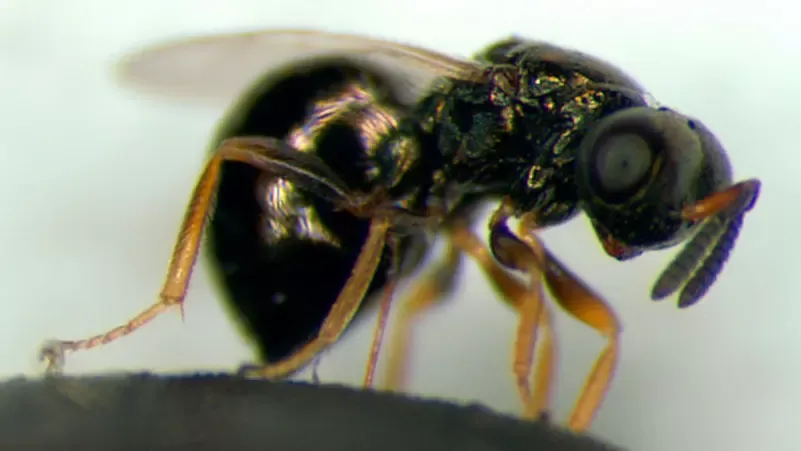
"The Jewel Wasp"... A rare insect that may hold the secret to slowing down aging.
Arab Sea Newspaper - Follow-ups
Arab Sea - Follow-ups: A recent study by the British University of Leicester revealed a remarkable biological discovery: a rare insect known as the "jewel wasp" (Nasonia vitripennis) may hold the key to slowing down aging and extending lifespan. This small wasp, which first appeared in the United Kingdom in 1998, is characterized by its shiny metallic color and predatory behavior, as it lays its eggs inside the bodies of other insects so that its larvae can feed on their entrails. Despite its harsh nature, it has attracted the attention of scientists due to its possession of a biological system known as "DNA Methylation," which is the same system that regulates genes in humans and is considered one of the essential keys to understanding and controlling aging. Experiments have shown that the larvae of this wasp can enter a state called "diapause" - a type of temporary hibernation induced by cold and darkness - which led to a slowing of biological aging by 29% and an increase in average lifespan by more than 30%. Professor Eamon Mallon, who supervised the research, explained that the results confirm the possibility of environmentally reprogramming aging, noting that differentiating between chronological aging (the number of years since birth) and biological aging (the actual state of cells) is crucial to understanding this phenomenon. This research is the first of its kind to prove the possibility of "freezing" aging in invertebrate organisms, opening the door to future studies that may lead to medical strategies to slow down aging in humans.