


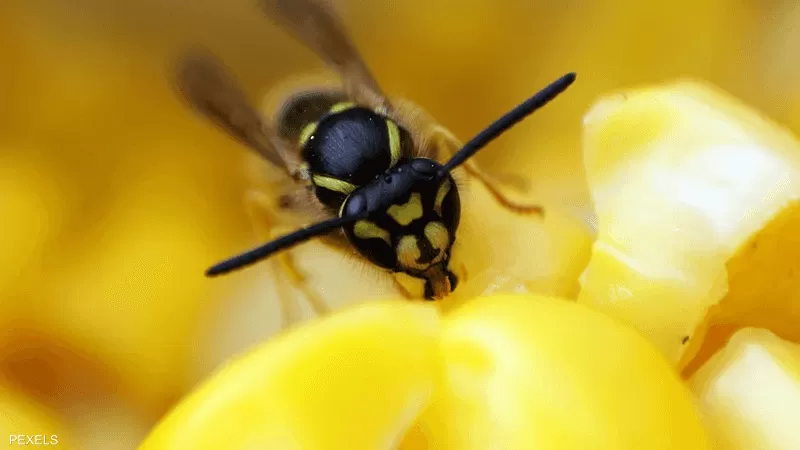
Not a fantasy or illusion... a wasp guides scientists to the "secret" of slowing down aging.
Arabian Sea Newspaper - Special
((Arabian Sea)) Translations: Using insects to stop aging may seem like an idea inspired by science fiction films, but researchers from the British University of Leicester claim that a certain type of wasp may hold the key to that - the "jewel wasp." This wasp, which is characterized by a shiny metallic body instead of the usual yellow and black colors, is known for its predatory behavior in the insect world, where it lays its eggs inside the bodies of other insects, so that the larvae feed on their victims from the inside. But what caught the attention of scientists is not its aggressiveness, but its amazing ability to "freeze time" inside its body. Despite the short lifespan of these wasps, the research team discovered that they have an advanced system for modifying gene expression known as "DNA methylation," which is a mechanism responsible for determining the function of each cell in the body. Surprisingly, this system is similar to what exists in humans. But the major breakthrough came when scientists noticed a unique phenomenon: the larvae of this wasp can enter a state similar to "biological hibernation" when the mothers are exposed to cold and darkness. During this state, the larva's growth stops... and with it, biological time stops. Freezing time... and prolonging life The researchers found that the larvae that underwent this state later grew normally, but lived more than 30 percent longer compared to their peers. It also turned out that their biological aging was 29 percent slower. Here, scientists distinguish between "chronological" aging, which is measured by the number of years, and "biological" aging, which is measured by the state of cells and tissues. You may look young on paper, but your cells may say otherwise. Professor Eamon Mallon, a specialist in evolutionary biology and supervisor of the study, stated: "It's as if these wasps stored extra time in the bank by taking an early break in life. This proves that aging is not inevitable... but can be manipulated environmentally." New hope in the science of aging For the first time, this study proves that biological aging can be slowed down and modified in an invertebrate organism. Scientists now hope to use this discovery as a starting point for advanced research in human aging. Professor Mallon adds: "Understanding how and why aging occurs is a major scientific challenge. This study opens new doors not only in entomology, but in our dream of designing medical interventions that slow down aging from its molecular roots." He concludes by saying: "This small wasp may seem trivial... but it may hold great keys to slowing down time itself."