


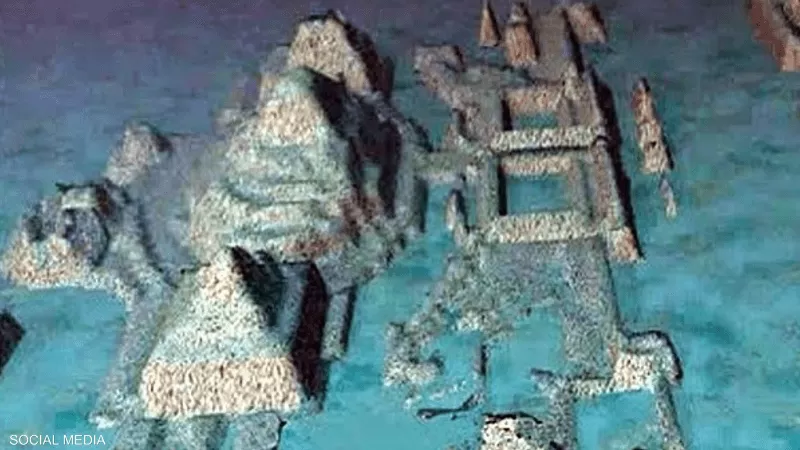
Sunken City... Does the bottom of the Caribbean Sea hide the secret of a lost civilization?
Arabian Sea Newspaper - Special
((Arabian Sea)) Translations: Recently, talk has resurfaced on social media about a sunken city believed to belong to an ancient civilization at the bottom of the Caribbean Sea off the coast of Cuba, more than 25 years after its discovery without further investigation. In 2001, a team of explorers led by marine engineer Paulina Zelitsky and her husband, Paul Weinzweig, announced the discovery of strange stone structures at a depth of over 2,000 feet below the sea surface near the Guanahacabibes Peninsula in western Cuba. Sonar images showed what appeared to be pyramids, circular structures, and other buildings, prompting Zelitsky to say at the time: "It's a really amazing structure, and it looks like a huge urban center." Some researchers estimated the age of this mysterious city to be over 6,000 years, making it older than the pyramids of Egypt, which would change the known timeline of human civilization's development. However, the discovery, which could have revolutionized archeology, was left without follow-up, as no subsequent expedition to the site has been organized since then. Some scientists attribute this neglect to scientific skepticism about the site, with some saying that a city could not sink to this depth in just 6,000 years, which, according to tectonic assumptions, would require at least 50,000 years. Others believe that these "structures" are natural rock formations, ruling out the possibility of an urban center being preserved in this way after a seismic disaster. For his part, Cuban geologist Manuel Iturralde-Vinent from the Museum of Natural History in Cuba said that it is "irresponsible" to determine the nature of these structures before verifying them, while Zelitsky stated in an interview with the BBC in 2001: "It would be irresponsible to say what this is before we have the evidence." Despite the initial interest, plans to return to the site were not implemented, and it is believed that political and financial reasons prevented this, especially since the original project was in cooperation with the government of Fidel Castro, and the official Cuban institutions, including the National Museum, did not show subsequent interest in researching the site. In 2002, American oceanographer Sylvia Earle also revealed that an expedition was canceled due to lack of funding. In contrast, archaeologists confirm that the current findings do not support the existence of a sunken city at this depth and time, noting that modern humans 50,000 years ago were still in the hunting and gathering stage and had not yet established advanced urban societies. Geologist Iturralde told The Washington Post: "This is really strange, we have never seen anything like this before, and we have no explanation for it." Michael Faught, an expert in underwater archeology from Florida State University, explained that "it would be great if Zelitsky and Weinzweig were right, but these structures are too advanced compared to what we know about the civilizations of the New World at that time." It is worth noting that the Cuban site is not the only one that has sparked scientific controversy about ancient structures believed to predate known civilizations, such as Göbekli Tepe in Turkey and the Yonaguni Monument underwater near Japan, both of which date back thousands of years before the pyramids.