
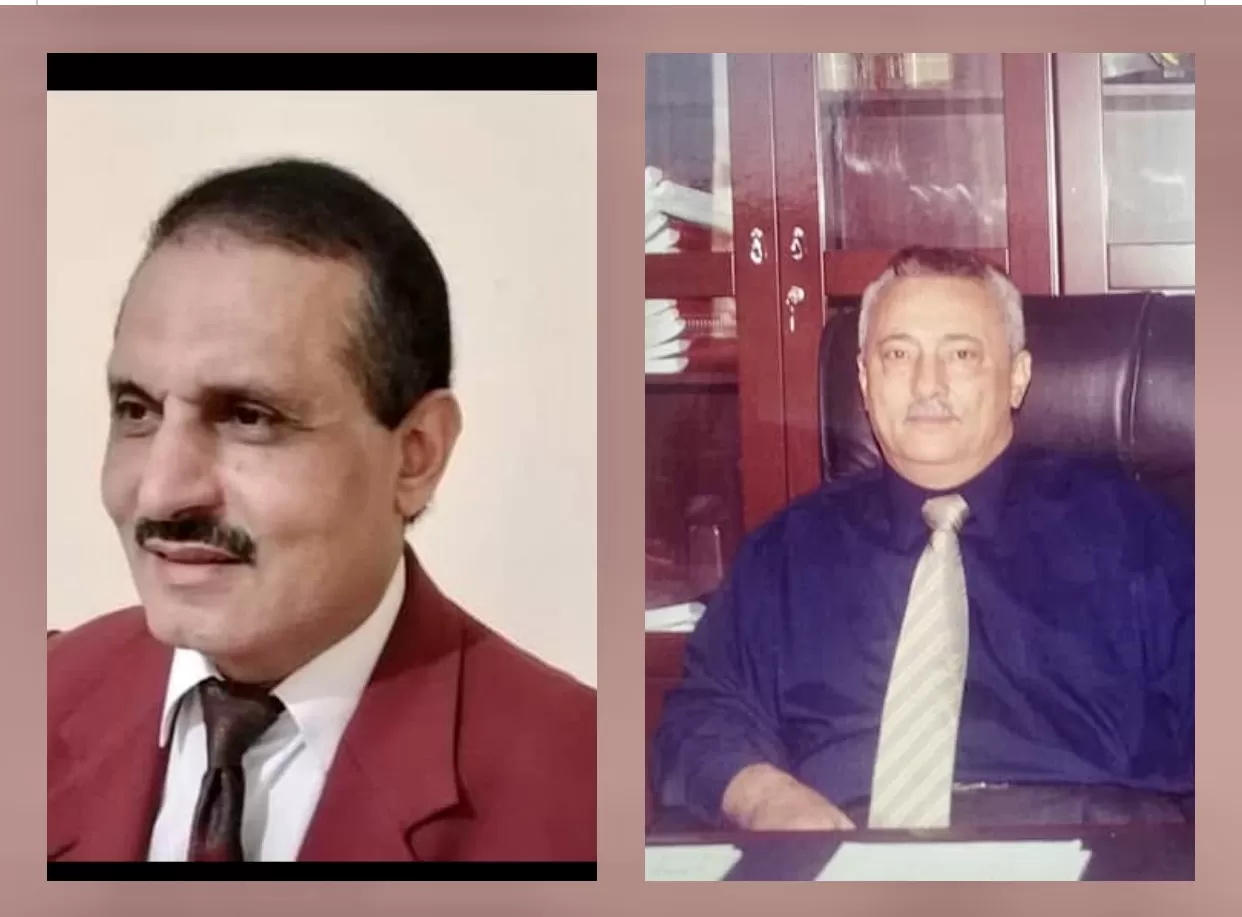
The scholar, thinker, and poet Ahmad Ali Hamadani
A high-level intellectual dialogue between the writer Mahmoud Kandil and Professor Ahmed Ali Al-Hamdani.
Arabian Sea Newspaper - Special
A high-level intellectual dialogue between the writer Mahmoud Kandil and Professor Ahmed Ali Al-Hamdani Arab Sea - Cairo - Follow-ups In a unique meeting that brought together the literary and intellectual figure, the great novelist, critic, and writer Mahmoud Kandil, and his companion in letters and knowledge, Professor Ahmed Ali Al-Hamdani, a deep intellectual dialogue took place in February 2021, addressing issues of literature, identity, knowledge, and the role of the intellectual in confronting the crises of the Arab and Islamic reality. Dialogue Topics The discussion focused on a number of central issues, most notably: • Literature as a soft power of resistance in times of great transformations. • The role of the Arab intellectual in dismantling hate speech and fanaticism and building a rational collective consciousness. • The relationship between fictional creativity and social and political reality, and how texts can become bridges for change. • Scientific research as a soft power for the nation, and the importance of linking universities with centers of thought and literature. The Value of the Meeting This dialogue came to confirm that the meeting of the word with scientific research constitutes a qualitative addition to the Arab collective consciousness, and represents a model for integration between the creative writer and the academic researcher. The meeting was characterized by a constructive critical spirit and a future vision, anticipating the horizons of literature and thought in the service of national and humanitarian issues. This dialogue was not fleeting, but rather reflects the stage's need for a partnership between thought, literature, and academic research, to generate a new discourse that confronts the challenges of identity, extremism, and the decline of human values in a time noisy with transformations. The following is the text of the dialogue: Dr. Ahmed Ali Al-Hamdani: * I mastered the Russian language and read a lot of Russian literature, so I embarked on the path of translation. * The cultural scene in Yemen is unstable in the current times and circumstances. * The future of Arab culture is promising, despite the chaos and attempts to destroy the Arab person. * President Putin's decision to award him the Pushkin World Medal moved him from local and national to global. * He presented critical studies in poetry, narrative, and folk literature to Arab culture. Our guest is a great Yemeni critic, translator, and poet, born in early autumn of 1951 in Aden (South Yemen). He studied the Quran and jurisprudence at an early age, and loved reading, so he devoted himself - in his early youth - to reading stories, epics, and popular Arab biographies that - as he says - influenced his soul and mind, and opened wide doors to poetry and prose. He participated in national action through his membership in the Popular Organization of Revolutionary Forces of the Liberation Front of South Yemen (against the British occupier), and was imprisoned until President Qahtan Al-Shaabi released him by a republican decree immediately after independence. Our esteemed scholar obtained a master's degree from the Soviet Union (Simferopol University in Ukraine) in 1984, for his thesis "Objective Dimensions and Artistic Characteristics in Chekhov's Plays." He obtained his doctorate from Moscow University in 1989 for his dissertation "Chekhov in Arab Criticism." He has about 57 books in criticism, translation, biographies, and poetry, including: Studies in the Yemeni Story - Folk Literature and its Relationship to Literature - Yemeni Folklore - Reading in Creativity and Other Things - Introduction to Literary Science (translation) - Texts from Russian Literature (translation) - Al-Zubairi, Poet of Change in Yemen (biographies) - Al-Hamdani's Diwan - Announce Now (poetry). He held the position of Vice President of Aden University from 1995 to 2014, and currently works as a professor of modern literature in the Faculties of Education and Arts (Aden University). We had this meeting with our professor, Dr. Ahmed Ali Al-Hamdani. Dialogue Mahmoud Kandil You have written poetry, practiced criticism, and celebrated translation, so which of these colors is closest to you? - Writing poetry, classifying criticism, and practicing translation are all close to my heart. I started my literary life with poetry in the seventies. The beginning was in vertical poetry in the early seventies. I have been writing criticism since the second half of the seventies. I practiced translation in the early eighties after mastering the Russian language and reading a lot of Russian literature, so I translated works of different shapes, genres, and types. My studies in the former Soviet Union were good in many aspects of life and culture. My contact in the Soviet Union was with many Soviet people who belonged to different nationalities. I got to know many people from different continents who were with us in the classroom; which enabled me to know their customs, morals, and ways of life. The Russians and Ukrainians were the people I integrated with the most. I read their stories and learned about their proverbs and riddles. I devoted myself to Russian theater and watched dozens of plays and dozens of films. The Russian writer Chekhov attracted me to him more than others, so I attended all his major and one-act plays. You obtained your doctorate from Moscow University in 1989 for your dissertation "Chekhov in Arab Criticism." Why did you choose Chekhov over other giants of Russian literature? Chekhov was an end and a beginning at the same time in the history of Russian and world literature. It was the end of one stage and the beginning of another. I got to know him in the late seventies and studied him closely in the eighties in an extensive study and devoted myself to his works, reading and examining them. My master's thesis was about him under the title of Objective Dimensions and Artistic Characteristics of Chekhov's Plays in 1984, and I had translated some of his works in Simferopol in the Crimean Peninsula, where I lived for 5 years. I made a decision to write a doctoral thesis about him and his relationship from this or that aspect with the Arabs and Arab literature. I decided to write about the evaluation of Arab criticism of Chekhov's theatrical and narrative experience. How the Arabs viewed him and defined his theatrical and narrative literature. The main problem I faced was how to obtain Arab critical writings, as there was nothing of it in Yemen. I headed towards the great and beautiful Egypt. Most of the Arab critics who wrote about Chekhov and whose works fell into my hands were from Egypt, which shaped my culture and my view of life and people from the seventies to this day. I was raised on what the Egyptian brothers and giant professors wrote. I extend my sincere thanks and great gratitude to Professor Dr. Samir Bibars, the distinguished scholar, who provided me with many of the works that were published in Egypt. Chekhov is a lavish artistic model for anyone who wants to write a play, short story, and story. He presents to the reader a high artistic technique that defined the features of theatrical and narrative writing. Chekhov emphasizes in his works the values of true beauty and belief in work and its ability to change people and life, and expressed in his narrative and theatrical literature the call to the future. He believed that the future would be beautiful and bright, and all of this was reflected in the Arab criticism's understanding of Chekhov's creative experience. How do you see the literary scene in Yemen, especially after what was called the "Arab Spring revolutions"? The Yemeni cultural scene is completely unstable, especially in the current times and circumstances. The Arab Spring revolutions have reaped the lives and people in our Arab world without exception; although their effects vary in each country separately. The unjust war broke out on Syria, Yemen, Libya, Iraq, and others, which weakened the movement of culture and thought. Yemen had made tangible progress in raising the morale of intellectuals and in laying the foundations of the cultural movement; publishing and printing houses spread, and the Yemeni book spread widely in various genres and forms, and the youth creative movement, male and female, advanced. The year 2004, when Sana'a was the capital of Arab culture, was an unprecedented cultural event, as the state printed a very large number of works of different directions, genres, and forms. All of this was disrupted and these revolutions spoiled all of this, so culture declined and the process of spreading the book regressed. But there are successful self-efforts by creative young people in Aden, Sana'a, and other cities without government support. Your Diwan entitled "Announce Now" resonated highly in the sky of Yemeni creativity in 2012. Is this due to the unique features that the poems included? - The Diwan "Announce Now" is a reflection of the events that have passed and are passing in some countries of the Arab world. It was a conscious response to what happened and is happening in Yemen, Syria, Libya, and Iraq. And in other parts of the Arab world crushed by conspiracies and encroachment on creative freedom. "Announce Now" was directed directly to the heroic and steadfast Syria. But these poems expressed all of this and more than this in a refined artistic architecture far from screaming and shouting. We would like you to tell us about the features of the Yemeni novel and about its most prominent writers in the current stage? The Yemeni novel has come a difficult way since the publication of the first Yemeni novel in Aden in 1939 by the pioneer of the enlightenment movement in Yemen, the great thinker Muhammad Ali Luqman, who published his second novel in 1947 under the title Kamala Devi or the Pains of a People. The Yemeni novel has made tangible progress; despite going through labor pains that cost it a lot