

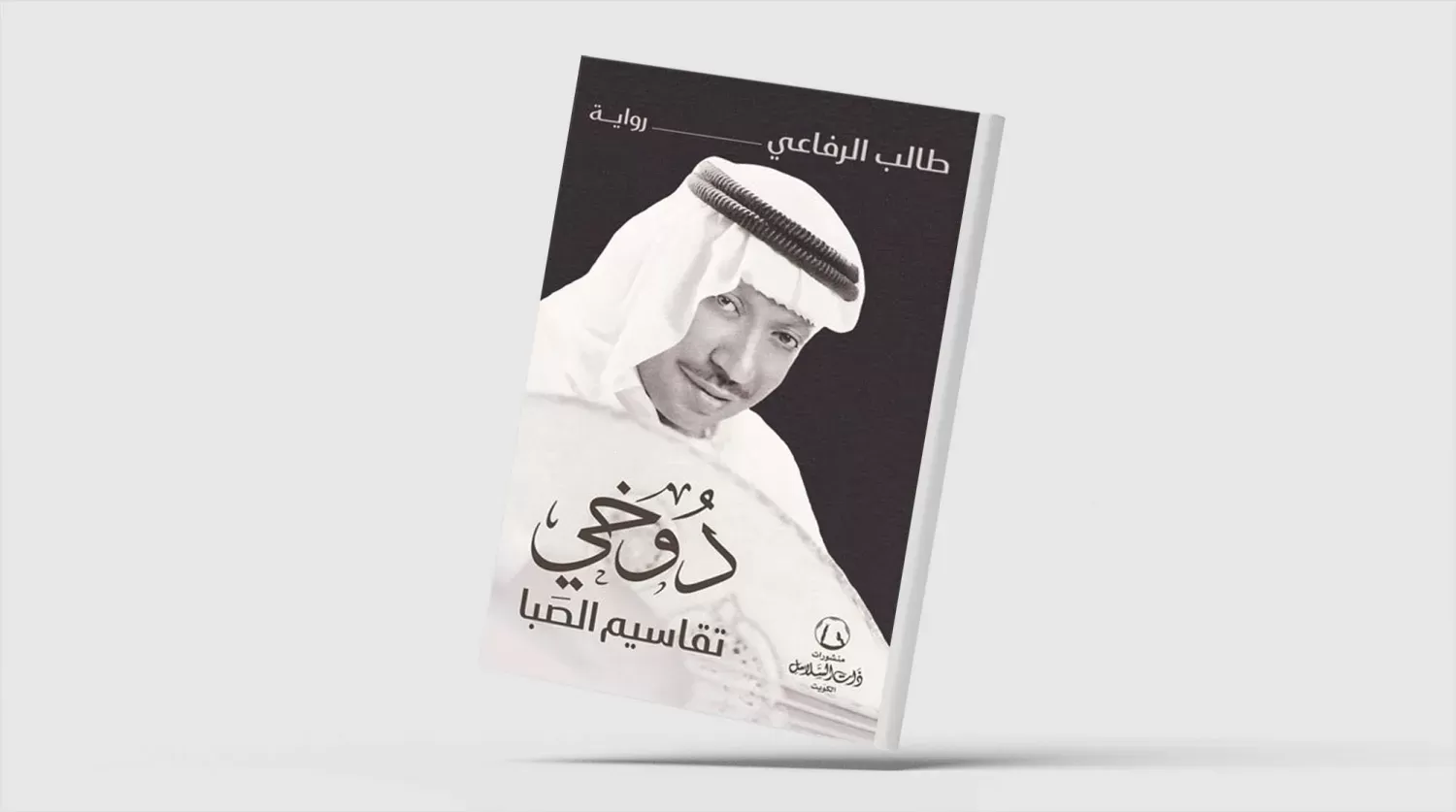
Al-Rifai student draws inspiration from the story of the famous Kuwaiti artist.
"Dukhi... Melodies of Youth"... A story of a society through a voice.
Arabian Sea Newspaper - Special
**Arab Gulf - Follow-ups:** **In his novel "Dukhi... Divisions of Youth" (That Al-Salasil. Kuwait 2025), the Kuwaiti novelist Taleb Al-Refai addresses the biography of the Kuwaiti artist Awad Dukhi, going beyond simply recalling a distinguished singing figure. He delves into the structure of Kuwaiti and Gulf society through the story of a voice, reconstructs a forgotten history through the echoes of song, and transforms the individual biography into a collective tale reflecting the social and cultural changes that the region witnessed in the second half of the twentieth century.** **The novel begins in 1979, at the moment of the artist's death, as he lies on his bed, surrounded by his family and friends, facing the stormy Kuwaiti night and its roaring winds. The opening scene takes the reader back to those last hours of the artist's life, but it does not present them in a traditional way. Al-Refai weaves it through the technique of successive scenes, where the present time intertwines with flashes of memory, and multiple voices juxtapose: the doctor, the brothers, the mother, the wife, the sisters, and the friends, alongside the voice of the reciter who fills the room with his recitation, and the voice of the sea that is present as an eternal memory.** **This multiplicity of voices forms the structure of the novel, giving the reader the impression of being inside a final musical concert, where human voices mix with the sounds of nature, and the room in which Dukhi lies becomes a vast stage that brings together the past and the present. Here, narration meets chanting, the story meets the melody, and memory meets the voice.** **The novel is rich with characters that revolve around one axis: Awad Dukhi. The family is strongly present; the mother who carries the burden of her son and recalls the bitterness of losing her husband, the brother Youssef who forms a mirror to Awad's voice and a guardian of his memory, the wife Umm Fahmi who moves between anxiety and patience, and the sister Umm Badr who translates her crying into prayer. Each character represents a face of the human experience that Dukhi lived: motherhood, brotherhood, partnership, kinship.** **However, the most unique character is that of the mysterious "companion" or "friend" who accompanies Awad since his birth, appears to him in dreams and visions, and manifests himself at moments of illness and death. This mysterious figure is not a ghost in the traditional sense, but rather a symbolic image of the art of singing itself, the echo of music that is born with the artist and does not leave him until death. He is another face of the self, and an internal witness to the journey of life, which transforms the singing biography into an existential experience with spiritual dimensions.** **The secondary characters appear to confirm the social nature of the novel, and to make Dukhi's life a mirror of the major transformations that Kuwait experienced, from the time of ships and diving to the time of radio and recordings, from a sea society to a city society.** **Al-Refai does not present his hero in the novel as a passing singer in the history of Kuwaiti art, but rather as one of the voices that shaped the features of Gulf singing, and linked the legacy of the "Nahhamah" on the backs of ships with the modern song that began to impose its presence through radio and records.** **One of the most important messages of the novel is that localism does not mean isolation, but rather means starting from the roots towards the world. Awad Dukhi's experience clearly reflects this dimension: the son of a limited environment in old Kuwait, but with his voice and songs he became known in the Gulf and the Arab world, and became a voice capable of transcending the boundaries of the small place to reach the ears of a wide audience.** **The novel depicts how the local voice becomes part of a larger collective memory. Awad Dukhi did not sing for sailors alone, but sang for lovers, for the displaced, for those searching for meaning in a time of transformations. His voice became capable of carrying the concerns of the Gulf interior and opening up to the Arab exterior, to be a witness that art is born in a limited environment, but it transcends these boundaries with its ability to express human emotion.** **Between Reality and Imagination** **The son of the late artist, Bassem Awad Dukhi, presented the novel with an introduction entitled "Nokhatha of Entertainment." This introduction opens the text to an emotional and personal dimension, as the son writes as a witness from within the family, and an heir to the memory of the father and his echo. The son Bassem presents his father Awad Dukhi as a rare piece, an "antique" that does not repeat itself, and a voice that has not been affected by time, but its sweetness has increased as it has aged. The name "Nokhatha of Entertainment" conveys the image of the father as the captain of a musical ship in the sea of life, a man who carried his voice as a "Nahham" first and then as a well-established singer, sailing with his songs from Kuwait to the Gulf and the Arab world.** **This introduction is a declaration that the novel will sail in a very private area: the area of overlap between autobiography, artistic biography, and narrative fiction. Bassem places the father in the position of a popular legend, while Taleb Al-Refai takes it upon himself to transform this legend into a narrative material that is read as part of Kuwaiti cultural and social history.** **"Dukhi... Divisions of Youth" places the reader in front of a critical area in narrative writing: how can the writer narrate the life of a real artist, and transform it into a fictional text without falling into dry documentation or excessive fiction that cancels the realistic reference? This dilemma turns the text into a question in itself: where does imagination begin and where does reality end? And what gives the biography of another its energy if it turns into a novel?** **Taleb Al-Refai chose to write about Awad Dukhi as a historical figure, who has a documented existence in Kuwaiti and Gulf memory, and has an artistic production preserved in radio and recordings, and the testimonies of his contemporaries bear witness to it, but he did not stop at the limits of recording narration, and imagination appears through the character of the mysterious "companion" who accompanies Dukhi from birth to death, a presence that the document cannot prove, but it is necessary for the fictional world to be complete.** **This overlap raises questions about the legitimacy of narration: when the novelist writes about an artist who lived among people, does he have the right to create a metaphysical character to accompany him? And does what he writes become a fictionalization of history or a reinvention of it? The novel suggests that the biography is not complete without imagination, and that reality itself is fragile unless it is supported by narration, where the presence of the doctor, or the mother, or the brother Youssef, real characters known in the artist's life, is met by the presence of the mysterious other, the shadow owner that no one sees except the hero. Between these two limits, the text oscillates, so the reader is no longer able to accurately separate the document from the fiction.** **The author of "Al-Najdi" deliberately pushes the reader into this predicament. He does not want to present a "life story" written in the voice of the historian, nor does he want to write a "completely fictional novel." Rather, he seeks to mix the two in one fabric, where reality remains an indispensable ground, and where imagination remains an energy to interpret and expand that reality. In this way, the text turns into a hybrid writing; a biography of another saturated with imagination, and a novel tied to reality.** **This choice takes us back to broader questions about the function of literature: is it enough to retell the lives of others as they happened, or does literature suppose to fill the gaps, to turn silence into voice, and emptiness into meaning? Taleb Al-Refai goes to the second option, as official history preserves the achievements of Awad Dukhi, his songs, his participations, his appearance on radio and television, but the novel enters the dark area: what did he feel in his childhood when he lost his father? How did he comprehend the idea of death as a child? How did he live his struggle with the disease as he regained his voice, which was the source of his strength and life? These questions are not answered by documentation, but are invaded by fictional imagination.** **From here, it can be said that "Dukhi... Divisions of Youth" is a writing that resides in a border area, an area where the novel and the biography intersect, and in this area the dividing lines between truth and illusion dissipate, and the artist's life becomes a double mirror, reflecting what actually happened, and revealing what could have been said if he could have spoken about himself, so that the reader comes out of the text with a composite memory, about a real artist who formed part of Kuwait's musical history, and about a fictional character created by the writer to inhabit his imagination and continue to question him: which was closer to the truth, the document or the imagination?** **It is noteworthy that what Taleb Al-Refai achieves in this novel is a redefinition of the relationship between the biography of another and the novel, the biography records what happened, the novel evokes what could have been said, the biography documents the impact, the novel gives it a second soul. And in this second soul lies the value of literature, as an art that dares to dialogue with history, resist its silence, and give the characters a life that transcends their temporal existence to remain capable of questioning us today.**