

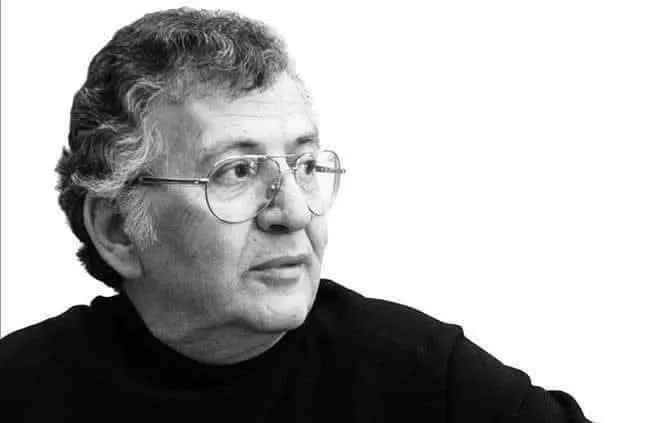
Samih al-Qasim: Life and Poetry, "The Most Prominent Poet of Resistance"
Arabian Sea Newspaper - Special
Arab Sea_Follow-ups: The poet Samih al-Qasim is one of the most prominent poetic voices in the Arab world and the Arab memory as a poet of resistance, and one of the most prominent poets whose personal life was intertwined with his literary and militant creativity. He combined the resistant word and the political stance, and literary creativity and national commitment. His poems carried the concerns of the cause and became a symbol of the voice of the resistant human being, and left a profound impact on modern Arabic poetry through his prolific collections and unique literary experience. "I walk upright, I walk with my head held high. In my palm is an olive branch, and on my shoulder is my coffin. My heart is a red moon, my heart is a garden with buckthorn and basil. My lips are a sky that rains fire sometimes, and love sometimes. In my palm is an olive branch, and on my shoulder is my coffin. And I walk, and I walk." These wonderful words, which people in the Arab world from the ocean to the Gulf repeated, belong to the greatest poet of the Arabs, Samih al-Qasim, one of the most prominent poets of Arabic in the modern era, who left a great legacy in poetry, theater, short stories, and novels. Many of his works have been translated into several languages, and he was given several titles, including: Poet of Palestine, Poet of the Sun, Lyre of Palestine, Mutanabbi of Palestine, and the Greatest Poet of the Arabs, among other titles that tried to express and celebrate the exceptional experience of Samih al-Qasim. The Birth and Upbringing of Samih al-Qasim... A Childhood Under the Fires of War Samih al-Qasim was born on May 11, 1939, in the Jordanian city of Zarqa to a Palestinian family, as his father worked in the border forces in eastern Jordan. Samih returned with his family to the city of Rama in 1941, where he received his education between the Rama Galilean School and the Nazareth School. In his childhood, Samih experienced a strange experience as an infant. When his family was on their way back to Palestine by train, the atmosphere of World War II was dominating the region. When al-Qasim, the infant, cried, the train passengers felt terrified that German army planes would be guided to them, which made his father brandish his weapon in the face of the passengers to silence them. When Samih grew up and knew that story, he was very affected and said: "They have tried to silence me since childhood, so I will speak at any time and in any place, and no one will ever be able to silence me." At the beginning of his working life, Samih worked as a teacher in a school before turning to political work, as he joined the Communist Party, and after a short period, he left the party and became preoccupied with literature and writing. Milestones in the Life of Samih al-Qasim... Literary and Political Struggle Samih never stopped resisting and working politically throughout his life, even while practicing literature, as his literary work was mixed with political work, which made him always face death threats, and he was fired from his job several times, in addition to entering prison more than once. Samih was placed under house arrest several times, and this period of Samih al-Qasim's life, imprisonment, and house arrest formed a large part of his poetic experience, which made him move between several jobs, from teacher to journalist to employee in Haifa Bay. At the journalistic level, Samih had great and remarkable efforts, as he contributed to the editing of both Al-Ittihad and Al-Ghad newspapers, in addition to his editorship of "This World" newspaper for a period of time, before returning to work again as an editor in Al-Ittihad, in addition to his work as managing editor of "Al-Jadeed" newspaper, then he became its editor-in-chief after a while. Samih al-Qasim founded a number of publications such as "Arab Sk" which he founded in Haifa, and became the director of the Popular Arts Foundation in Haifa for a period of time. Among the important positions that express the value of the great Poet of the Sun is his presidency of the Arab Writers Union and the General Union of Palestinian Arab Writers, in addition to being the honorary editor-in-chief of the "Kul al-Arab" newspaper that was published in Nazareth. Samih was also the editor-in-chief of one of the most important quarterly cultural magazines that was published under the title "Ida'at," and it had great fame at the literary and cultural level. Al-Qasim was imprisoned in 1960 for refusing to enlist in the Israeli army, which is the most prominent reason for Samih al-Qasim's imprisonment. He was always in conflict with the Israeli authorities, who placed him under house arrest from 1963 to 1968, as he was always demanding the rights of the resistant people, and he was a supporter of Arab nationalism, which was expressed by his positions and journalistic and literary writings. Thus, Samih al-Qasim's literary and political career formed two sides of the same coin. The Literary Experience of Samih al-Qasim: A Legacy of Poetry and Prose The literary experience cannot be separated from Samih al-Qasim's personal and professional life, as he started writing early and lived creatively in every moment, and his writings expressed his opinions and positions, so his poetry represented the pulse of the cause and a voice for the suffering of a people of heroes, which made him one of the most important poets of resistance and the most productive. Samih's poetry about his homeland is the cornerstone of al-Qasim's literary works, and no reading of the scene of Palestinian poets is complete without placing him alongside his companion and friend, the great poet Mahmoud Darwish. Mahmoud Darwish and al-Qasim represented the two poles of resistance poetry, and despite the deep friendship that brought them together, each of them had his own style. While Darwish soared in more symbolic and cosmic poetic spaces, al-Qasim remained rooted in the language of direct challenge and anger associated with the land. Samih had not completed 30 years of his life when he published six poetry collections, which is amazing, as many great poets have not written 6 poetry collections in their lives, yet these collections were of high quality, which made them very famous, and al-Qasim's name became a big and bright name in the sky of Arabic poetry in the seventies of the last century. Al-Qasim wrote a number of literary forms. Despite his fame as a poet of classical Arabic, he also wrote a number of novels and plays, in addition to short stories, in addition to literary articles of a critical nature due to his work in journalism. The poetic experience of Samih al-Qasim is characterized by combining revolutionary anger and human tenderness, and using heritage and religious symbols in a contemporary context, and his strong language that ranges between shocking directness and deep symbolism. At the level of criticism, writers and critics have dealt with al-Qasim's experience with great interest, and many books and studies have been published, some of which talked about him being one of the pioneers of the post-modern movement in Arabic poetry, and some poets placed him in a high position as one of the best Arab poets in the modern era. Samih al-Qasim Awards The great poet Samih al-Qasim won a number of awards, and received many honors, shields, certificates of appreciation, and honorary memberships that befit his literary status and creative experience, and perhaps the most prominent of these awards are the following: The Gar الشعر Award from Spain. Two awards from France for his works translated into French by the Moroccan writer Abdellatif Laabi. The Babtain Prize for Arabic Poetry. The Jerusalem Medal for Culture twice. The Naguib Mahfouz Award from Egypt. The Peace Award from the Oasis of Peace. The Palestinian Poetry Award. Samih al-Qasim's Works In an experience that is considered one of the most prolific Arab experiences at the level of production and sophistication at the level of creative quality, the works of the poet Samih al-Qasim reached about 87 creative works, distributed between poetry, theater, prose, short stories, novels, translation, and research. Perhaps the most prominent of his works are the following: Samih Qasim's Poetic Works Samih's poetic works varied, reaching 23 collections: Processions of the Sun in 1958. Songs of the Paths in 1964. My Blood on My Palm in 1967. Volcano Smoke in 1968. The Fall of Masks in 1969. And it Happens that the Thunder Bird Comes in 1969. The Quran of Death and Jasmine in 1971. The Great Death in 1972. And They Did Not Kill Him and They Did Not Crucify Him, But It Was Made to Appear to Them in 1976. The Diwan of Enthusiasm in 1978. I Love You as Death Desires in 1980. The Dark Side of the Apple, the Bright Side of the Heart in 1981. Directions of the Soul in 1983. Sacrifices in 1983. I Do Not Ask Anyone's Permission in 1988. The Seven Books in 1994. Jasmine in 1995. I Will Get Out of My Picture One