
Johannesburg: G20 Summit Kicks Off in Africa Amid Notable US Absence
Arab Sea Newspaper - Follow-ups
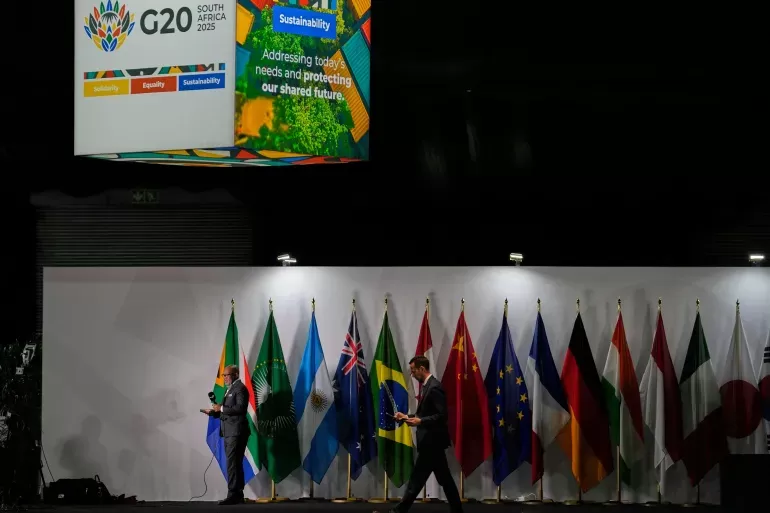
The G20 leaders' summit kicked off today, Saturday, in Johannesburg, South Africa, in a historic event held for the first time on African soil, with the participation of representatives from 42 countries and international institutions, amid the absence of US President Donald Trump, and widespread media attention, in light of unprecedented global economic challenges. South African President Cyril Ramaphosa affirmed in the opening session that the summit represents an opportunity to strengthen partnership and cooperation between countries to reach joint solutions to global crises, stressing that international understanding is a prerequisite for achieving sustainable development. He called for increased investment in developing countries, reducing the risks of climate change, improving support for disaster-stricken areas, and putting an end to poverty and unemployment, especially in the countries of the South. For his part, French President Emmanuel Macron warned that the G20 is facing great difficulty in addressing major international crises, noting that the absence of some members, including the United States, makes it more difficult to achieve global consensus, warning that the group may be "on the verge of the end of a cycle" if major countries do not move collectively. The absence of US President Donald Trump is considered the most prominent event at the summit, as he announced his country's boycott, accusing the host country of practicing discrimination against whites during the previous era of apartheid, although Washington sent a representative to attend the handover ceremony of the rotating presidency without participating in the summit's proceedings. Also absent from the summit were Chinese President Xi Jinping, represented by Prime Minister Li Qiang, Russian President Vladimir Putin, represented by Maxim Oreshkin, and Argentine President Javier Milei, as well as high-level representatives from Nigeria and Mexico, while senior world leaders attended, including: French President Macron, Indian Prime Minister Narendra Modi, German Chancellor Friedrich Merz, British Prime Minister Keir Starmer, Turkish President Recep Tayyip Erdogan, Brazilian President Lula da Silva, and the Emir of Qatar, Sheikh Tamim bin Hamad Al Thani, in addition to senior officials from the European Union and the United Nations. South Africa seeks to highlight the issues of the countries of the South, including: * Addressing economic inequalities and improving development financing for fragile states. * Increasing preparedness to face climate disasters and enhancing climate financing. * Restructuring and alleviating debt for poor countries. Protecting local communities and countries exporting vital minerals, in light of international competition for African resources. Experts confirm that the summit represents an important moment for the African continent and developing countries, despite the absence of some leaders. Johannesburg witnessed unprecedented activity in preparation for the summit, with the deployment of more than 3,500 police officers and the army on alert, in addition to decorating the roads leading from OR Tambo International Airport to the city center with banners and colorful flowers, while President Ramaphosa personally appeared on the streets to help with the organization and cleaning work, in a remarkable symbolic step. Despite these efforts, some citizens criticized the cost of the summit in light of economic pressures and the high unemployment rate of about 31%, stressing the need for these meetings to translate into tangible policies that support citizens. The G20 was established in 1999 and includes 19 countries in addition to the European Union and the African Union, and together they represent 85% of the global gross domestic product and two-thirds of the world's population. The group aims to promote global economic cooperation, discuss financial and political issues, and provide collective solutions to major international challenges, with a focus on partnership between developed and emerging economies. South Africa is assuming the presidency of the current summit after a full year of preparation, and will hand over the presidency to the United States at the conclusion of the two-day meeting at the "Nasrec" Exhibition Center, the largest conference hall in the country.