

Shanghai Summit Distances Donald Trump... Will Beijing Prevail in the Game of Global Influence?
Arabian Sea Newspaper - Special
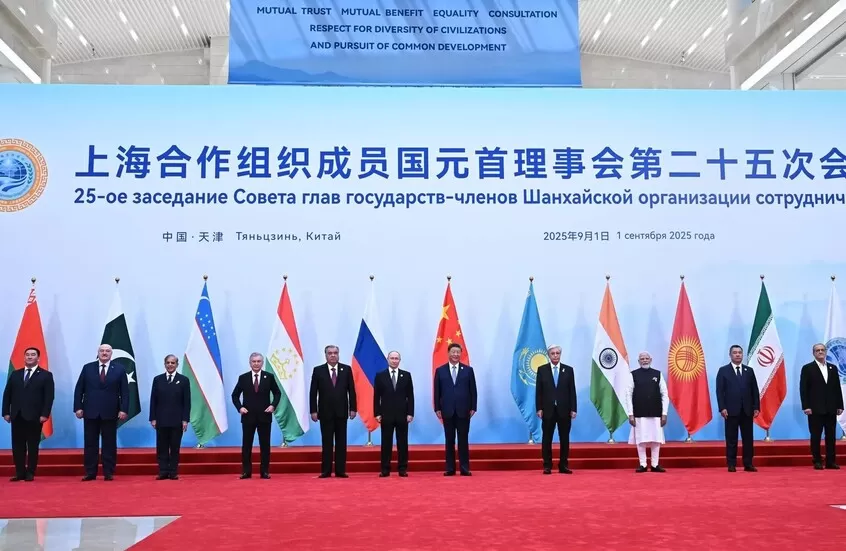
**Arab Sea - Follow-ups:** A Western report stated that Chinese President Xi Jinping sidelined President Donald Trump this week and shifted global attention to the Chinese city of Tianjin, which hosted the largest summit to date of the China-backed Shanghai Cooperation Organization. The summit witnessed the attendance of Vladimir Putin, Indian Prime Minister Narendra Modi, and Turkish President Recep Tayyip Erdogan, along with leaders from Iran, Pakistan, Egypt, Armenia, and Azerbaijan. The report, published by the Wall Street Journal on Tuesday, indicated that Putin's presence suggests that the Eurasian front remains united despite the Trump administration's attempts to create divisions between China and its allies. The presence of Iranian President Masoud Pezeshkian also confirmed Tehran's commitment to the cause of resistance, while Modi's presence sent an implicit message to Washington not to take India for granted. Although the Shanghai conference will not be remembered for its achievements, it represents an important step preceding potential negotiations between China and the United States on trade relations between the two great powers in the 21st century. The report likened the summit to a Maori "Haka" dance, in which teams show their strength before the real competition begins, reflecting Trump's readiness to confront China through policies of trade incentives and intimidation, while strengthening America's leadership in Europe. However, this strategy has not achieved similar success with Asian allies, as it has been difficult to mobilize them despite Japan's limited cooperation. According to the report, the summit highlighted the limits of Trump's power and the failure of his efforts to sow discord between Russia and China, while Putin's presence reflects his commitment to the alliance with the East. Chinese relations with Moscow and North Korea's expansion of its alliances show the difficulty Trump faces in dealing with these parties, as reaching Kim Jong-un will be more difficult than ever. Although the success of the "Haka" does not guarantee victory in the subsequent competition, China and the United States possess a combination of unequal strengths and weaknesses, making it difficult to predict the outcome of the conflict between them. Trump believes that China's need for the American market will force it to make concessions, while China believes that the world's dependence on its strategic products will pressure Washington to make similar concessions. Trump has previously faced weaker powers and achieved successes, but he is now facing a China-led alliance of stronger countries seeking to thwart the United States. The nature of the upcoming deal with China is likely to determine Trump's historical standing more than any other achievement during his presidency. Analysts who spoke to the New York Times believe that Indian Prime Minister Narendra Modi wants to emphasize during the summit that India has other important allies, including China, despite the ongoing border dispute, in an implicit message to the Trump administration about the dangers of continuing to isolate New Delhi with tariffs. Anuj Kewalramani, head of Indo-Pacific studies at the Takshashila Institution in Bangalore, India, said that the images of the leaders at the summit showed, with more than twenty leaders from Central and South Asia gathered, how China and Russia exploited the geopolitical turmoil caused by Trump to strengthen their position and mobilize partners such as Iran, Kazakhstan, Kyrgyzstan, Belarus, and Pakistan. The New York Times pointed out that China is seeking to exploit the unpopularity of the United States' chaotic trade policies to highlight the disagreement between Washington and the rest of the world, emphasizing its ability to provide a more stable model of global leadership.