

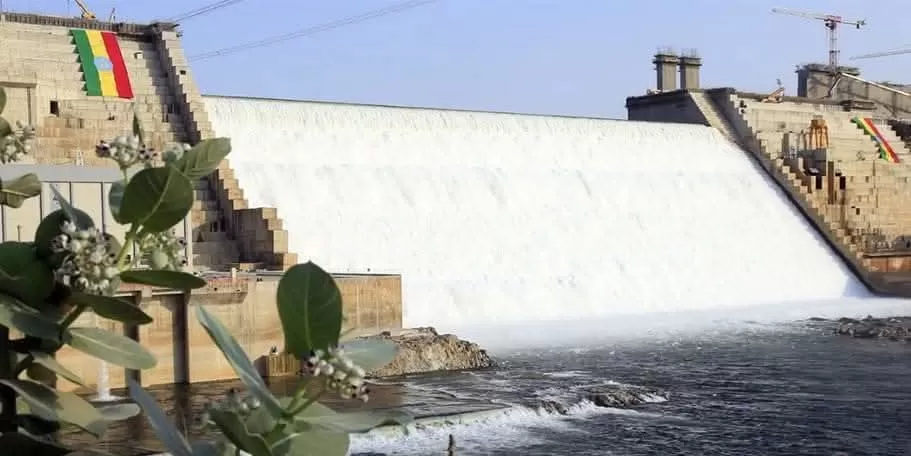
Ethiopia expects more than $9 billion annually in revenues from the Grand Renaissance Dam.
Arabian Sea Newspaper - Special
Arabian Gulf_Reuters: Ethiopia expects the Grand Ethiopian Renaissance Dam (GERD), which it built on the Blue Nile and is scheduled to operate in September, to generate revenues of $1 billion annually, according to Prime Minister Abiy Ahmed. The "Grand Ethiopian Renaissance Dam" project, which is causing tension with Egypt and Sudan, was launched in 2011 with a budget of $4 billion. It is the largest hydroelectric project in Africa, with a width of 1.8 kilometers and a height of 145 meters. Addis Ababa believes that the dam is necessary for its electricity supply program. Its capacity is 74 billion cubic meters of water, and it is capable of generating more than 5,000 megawatts of electricity, which is equivalent to twice Ethiopia's current production. "We expect $1 billion (in revenue) annually from this dam," Abiy Ahmed said in a televised interview with official media broadcast on Monday, stressing that these revenues will be invested "in other projects," according to Agence France-Presse. The Prime Minister indicated that Addis Ababa intends to establish "other projects, such as the Grand Renaissance Dam project, over the next five, ten, or 15 years." Egypt and Sudan have previously expressed concern about the operation of the GERD without a tripartite agreement, fearing that it would threaten the two countries' access to Nile waters. Negotiations have failed to make any significant progress. Ahmed pointed out that "many of our friends have discussed, warned, and threatened" Ethiopia about operating the dam, stressing his country's desire "that this dam does not cause concern or fears" for Cairo and Khartoum. Ethiopia, located in East Africa, is the second most populous country on the continent, with a population of about 130 million people and increasing electricity needs. A World Bank report in January 2025 stated that about 60 million Ethiopians are deprived of electricity, mainly due to a lack of networks. Egypt, which is already suffering from a severe water scarcity crisis, believes that the dam poses an existential threat to it, given its dependence on the Nile to cover 97% of its needs.